Texas Guns Firearms Education
What Was America's First Gun Law? The Complete History From the Second Amendment to Today
The American story did not begin with a ban—and it did not begin in 1934. It began with colonial rules that sometimes required arms and sometimes restricted their storage, use, carry or possession. The law has been pulling in both directions ever since.

The short answer: what was America's first gun law?
There is no single historically honest answer unless we define “first gun law.” British North American colonies regulated arms during the 1600s—long before the United States existed. Those rules included militia and defense mandates, gunpowder-storage and fire-safety rules, hunting and public-discharge restrictions, controls on trade, and discriminatory laws governing who could possess weapons.
After independence, the Second Amendment was ratified on December 15, 1791. The first major federal statute addressing citizens and arms was not a ban: the Militia Act of 1792 required enrolled eligible men to obtain specified arms and equipment. If the question means the first important federal restriction on firearms distribution, the Nonmailable Firearms Act of 1927 is an early landmark. If it means the first comprehensive modern federal gun-control system, the answer is the National Firearms Act of 1934.
Colonial rules from the 1600s; no single undisputed “first.” They mixed obligations, safety rules and restrictions.
The Militia Act of 1792, which required enrolled eligible citizens to furnish militia arms and equipment.
The 1927 law restricting the mailing of concealable firearms, subject to statutory exceptions.
The National Firearms Act of 1934, built around taxation, registration and advance approval.
First, know what kind of “law” you are reading
A common source of confusion is treating every legal event as though Congress passed it. American firearm rules come from different institutions, and each type of authority does a different job.
Sets the government's powers and limits. The Second Amendment restrains government; Article I gives Congress enumerated powers such as taxation and regulation of interstate commerce.
Are laws enacted by Congress or state legislatures. The NFA, GCA, Brady Act and Bipartisan Safer Communities Act are statutes.
Are agency rules implementing statutes. They cannot lawfully exceed the authority Congress delegated, which is why statutory interpretation cases matter.
Resolve cases and interpret constitutions, statutes or regulations. Heller interpreted the Second Amendment; Cargill interpreted a statute.
Federalism matters too. A federal rule, a Texas statute and a city ordinance can occupy different layers. The Second Amendment originally constrained only the federal government. It was not applied against state and local governments until McDonald v. Chicago in 2010. That is one reason nineteenth-century state laws and early federal cases can sound foreign to a modern reader.
Before the Second Amendment: colonial arms laws pulled both ways
The first surprise in this history is that early arms regulation was neither simply “pro-gun” nor simply “gun control.” Colonial governments viewed arms as tools of collective defense, sources of fire and public-order risk, valuable trade goods, hunting implements—and instruments of political power.
Legal historian Robert Spitzer's survey of early American gun laws documents regulations dating to the colonial period. In early seventeenth-century Virginia, for example, men were directed to bring firearms to church because settlements feared attack. Other colonies required militia-eligible residents to appear armed for musters or maintain specified weapons and ammunition. Those were laws about guns, but they promoted ownership and readiness rather than restricting them.
At the same time, dense settlements worried about sparks, fire and large quantities of black powder stored in homes or businesses. Governments regulated where powder could be stored, how much could be kept in occupied buildings and when guns could be discharged. Hunting rules protected game or landowners. Carry and public-order rules appeared in different forms. Laws also controlled trade with Native peoples and disarmed groups whose loyalty authorities distrusted.
That record is why a confident claim such as “America's first gun law was in 1934” is false. It is also why naming one colonial enactment as the unquestioned first is risky: the answer changes depending on whether we count militia orders, powder-storage laws, hunting rules, public-carry rules, trade restrictions or status-based disarmament.
1787–1792: constitutional structure, an individual right and a militia duty
The Constitution divided power before the Bill of Rights limited it
The Constitution gave Congress power to call forth, organize, arm and discipline the militia, while reserving to the states the appointment of officers and training authority according to federal discipline. It also gave Congress taxing and interstate-commerce powers that would later support federal firearms statutes.
Many ratification-era Americans still demanded an express declaration protecting arms. Congress proposed twelve amendments on September 25, 1789. The states ratified ten, including the Second Amendment, on December 15, 1791.
“A well regulated Militia, being necessary to the security of a free State, the right of the people to keep and bear Arms, shall not be infringed.”Second Amendment to the United States Constitution

1791 — The Second Amendment is ratified
Ratification debates reflected fear of concentrated national power, attachment to the militia and an understood pre-existing right to possess and carry arms.
The federal Constitution expressly prohibited infringement of the right of the people to keep and bear arms.
It did not create a federal firearm code, define every permissible regulation or initially bind state and local governments.
1792 — The federal government tells militia members to arm themselves
The first Militia Act authorized the President to call forth militia in specified emergencies. The second, enacted May 8, 1792, established enrollment and equipment rules. Its discriminatory terms covered each “free able-bodied white male citizen” of the relevant state between 18 and under 45. Enrolled men were required, within six months, to provide themselves with a musket or firelock and equipment—or a rifle and specified accoutrements.
The new republic lacked a large standing military and needed a standardized citizen militia for national defense and enforcement of federal law.
Congress created a national militia framework and imposed an arms-and-equipment obligation on the eligible enrolled population.
It did not create a universal individual mandate. Its racial and sex exclusions reveal how narrowly the political community was legally defined.
The nineteenth century: carry laws, racial disarmament and the Fourteenth Amendment
For most of the nineteenth century, the most visible firearm regulation occurred at the state and local level. The period also exposes the darkest use of arms law: denying weapons to enslaved people and, after emancipation, attempting to keep freedpeople defenseless.
States distinguish carrying from keeping
As concealable pistols and large knives became common, states enacted restrictions on concealed carry. Courts did not speak with one voice. Some decisions upheld limits on concealed carry while recognizing open carry or the underlying right; others struck down broader restrictions under state constitutional provisions. Surety laws sometimes allowed a person accused of threatening conduct to be required to post a bond before going armed.
This was not one nationwide system. Rules differed by state, enforcement differed by community and the federal Bill of Rights had not yet been applied to the states. A modern reader should resist turning scattered nineteenth-century enactments into a single national rule.
Race and citizenship become central
Before the Civil War, laws in slave states commonly prohibited enslaved people—and often free Black people—from possessing arms without permission. After the war, Southern Black Codes attempted to preserve racial control, including through weapons restrictions and selective enforcement. Congress responded with Reconstruction legislation. The Freedmen's Bureau Act of 1866 expressly protected the full and equal benefit of laws concerning personal liberty and personal security, including the constitutional right to bear arms. The Civil Rights Act of 1866 and the Fourteenth Amendment were part of the same struggle over citizenship and state abuse.
1868 — The Fourteenth Amendment is ratified
Reconstruction required constitutional protection for citizenship and civil rights against hostile state action after slavery.
Citizenship, privileges or immunities, due process and equal protection became federal constitutional commands directed at the states.
The Supreme Court did not then apply the Second Amendment to the states. Modern incorporation arrived much later in McDonald.
Cruikshank and Presser: the pre-incorporation rule
In United States v. Cruikshank (1876), arising from federal prosecutions after the Colfax Massacre, the Supreme Court said the First and Second Amendments did not grant rights but protected pre-existing rights from federal infringement; the Second Amendment, under the Court's then-prevailing doctrine, constrained the national government rather than private actors or states. Presser v. Illinois (1886) repeated that the amendment did not limit state legislation. Those cases reflect the nineteenth-century incorporation framework—not today's rule after McDonald.
1927–1939: the modern federal firearms system begins
Industrial production, national mail order, automobiles and Prohibition-era organized crime changed the scale of the issue. Congress increasingly used federal powers over the mails, taxation and interstate commerce.
1927 — The Nonmailable Firearms Act
The law restricted depositing pistols, revolvers and other concealable firearms in the U.S. mail, while providing exceptions for specified recipients and uses. It is best described as an early nationwide distribution restriction—not the first arms law in America and not a general ban on handgun ownership.
Lawmakers were concerned about concealable weapons moving anonymously through a national mail-order system and being used in crime.
The federal government used its control of the mails to restrict a channel of concealable-firearm distribution.
It did not forbid all interstate firearm sales, create the FFL system or prohibit ordinary handgun possession.
1934 — The National Firearms Act
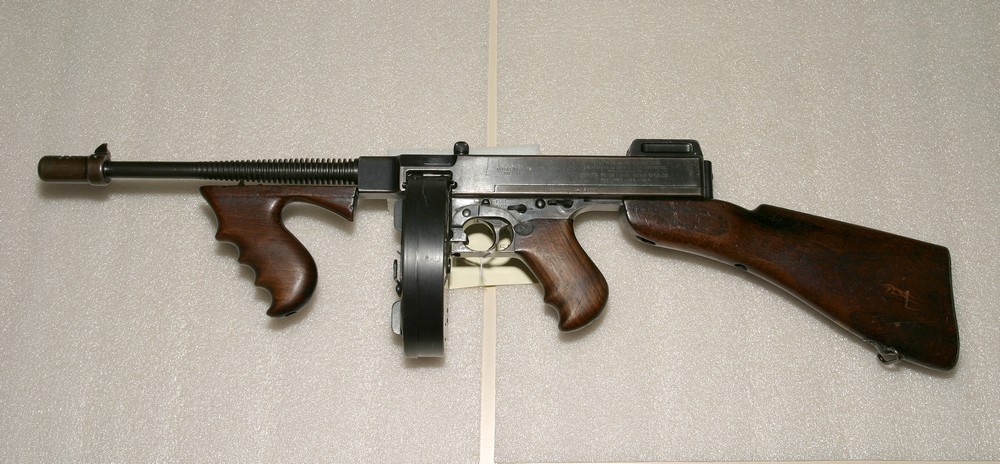
The NFA was Congress's answer to sensational Prohibition-era violence associated with gangsters, machineguns and concealable or shortened weapons. The St. Valentine's Day Massacre became an enduring symbol of the period, but the law was the product of a broader organized-crime debate.
Congress did not enact a simple possession ban. It used its taxing power: a $200 transfer tax, registration, identification and advance-approval requirements applied to machineguns, short-barreled rifles, short-barreled shotguns, silencers and “any other weapons.” Two hundred dollars in 1934 was deliberately burdensome. Pistols and revolvers appeared in early proposals but were removed before enactment.
Gangland violence, Prohibition-era organized crime and public alarm over machineguns and concealable weapons drove the legislation.
Selected weapons entered a federal tax-and-registration system backed by criminal penalties.
It did not ban all machineguns or silencers nationwide. Lawful acquisition remained possible under federal and applicable state law.
1938 — The Federal Firearms Act
The FFA used the commerce power to require licenses for persons engaged in interstate firearm manufacture or dealing, mandate records and restrict receipt by certain fugitives and people convicted of crimes of violence. It was the direct predecessor of the 1968 Gun Control Act.
Congress wanted more control over interstate dealers and movement of firearms to identified high-risk categories.
Federal dealer licensing, records and early federal prohibited-person rules entered the interstate market.
It did not create today's comprehensive FFL, serialization, import and prohibited-person framework.
1939 — United States v. Miller
The case involved interstate transportation of an unregistered short-barreled shotgun under the NFA. On the record before it, the Court said it could not take judicial notice that such a weapon had a reasonable relationship to preservation or efficiency of a well-regulated militia. The opinion did not declare that the right belongs only to state governments, nor did it decide the full modern scope of the individual right later addressed in Heller.
1968: assassinations, mail order and the Gun Control Act turning point
The assassinations of President John F. Kennedy, Dr. Martin Luther King Jr. and Senator Robert F. Kennedy did not create federal gun legislation from nothing. They accelerated years of debate over mail-order firearms, interstate crime, dealer regulation and prohibited buyers.
Lee Harvey Oswald obtained the rifle used to assassinate President Kennedy through mail order under an alias. Kennedy's 1963 assassination intensified proposals already under consideration. The 1968 assassinations of King and Robert Kennedy added political urgency. Congress passed the Gun Control Act, and President Lyndon B. Johnson signed it on October 22, 1968.
1968 — The Gun Control Act
The GCA replaced the 1938 FFA and became the foundation of today's federal retail system. It expanded federal licensing and records, restricted interstate transfers to nonlicensees, ended direct interstate mail-order sales to ordinary consumers, expanded prohibited-person categories, imposed age rules for FFL sales, strengthened marking and serialization requirements and regulated imports.
Title II revised the NFA after Haynes v. United States held that compelling a prohibited possessor to register could violate the Fifth Amendment privilege against self-incrimination. The revised system placed registration duties on lawful makers, manufacturers, importers and transferors and protected registration information from direct use in certain prosecutions.
National assassinations, mail-order access, interstate crime and dissatisfaction with the limited 1938 framework converged.
The modern FFL, interstate-transfer, prohibited-person, recordkeeping and import system took shape.
It did not create universal federal registration of ordinary firearms or a federal background check for every private intrastate transfer.

1986–2005: today's federal framework takes shape
1986 — Firearm Owners' Protection Act and the machinegun cutoff
FOPA was enacted after years of complaints that federal enforcement under the GCA burdened lawful owners and dealers. It narrowed parts of the “engaged in the business” definition, limited certain inspections, protected qualifying interstate transport and made other changes sought by firearm owners and the industry.
During passage, the Hughes Amendment added 18 U.S.C. § 922(o). With limited exceptions, it barred civilian possession or transfer of machineguns not lawfully possessed before May 19, 1986. This created the familiar “transferable machinegun” cutoff.
The core bill answered perceived enforcement abuses and interstate-travel problems; the machinegun amendment emerged during floor consideration.
Lawful-owner protections expanded, while the civilian transferable machinegun pool was frozen.
It did not make all pre-1986 machineguns unregulated. Transferable examples remained subject to the NFA and state law.
1988 — Undetectable Firearms Act
Fear that emerging polymer firearms could pass unnoticed through security screening drove this law. It established federal detectability standards. It did not ban ordinary polymer-framed pistols, which contain detectable metal.
1990–1996 — Gun-Free School Zones Act, Lopez and revision
The 1990 act created a federal offense for possessing a firearm in a school zone, subject to exceptions. In United States v. Lopez (1995), the Supreme Court invalidated the original version because it exceeded Congress's Commerce Clause authority. Congress revised the law in 1996 to add an interstate-commerce connection. The episode is a reminder that a policy goal does not erase constitutional limits on federal power.
1993–1998 — The Brady Act and NICS
James Brady was permanently disabled in the 1981 assassination attempt on President Ronald Reagan. Brady and his wife, Sarah, became prominent advocates for federal background checks. The 1993 Brady Act created an interim handgun waiting-and-check system and directed creation of the National Instant Criminal Background Check System.
In Printz v. United States (1997), the Supreme Court held that Congress could not commandeer state and local chief law-enforcement officers to perform the interim checks. The decision did not invalidate the permanent federal NICS system. NICS began operation on November 30, 1998.
The Reagan shooting, advocacy by the Bradys and concern that prohibited people could buy from dealers without a national check drove the act.
Licensed-dealer transfers became tied to a national eligibility check, first through an interim system and then NICS.
It did not create a federal check for every private intrastate transfer or make every non-“proceed” result a permanent denial.

1994–2004 — Federal Assault Weapons Ban
The Violent Crime Control and Law Enforcement Act prohibited manufacture, transfer and possession of defined “semiautomatic assault weapons” and new large-capacity ammunition-feeding devices, with exceptions and grandfathering for items lawfully possessed before enactment. The definitions depended on named models and combinations of features—not simply whether a firearm was semiautomatic or looked military.
Congress included a ten-year sunset. The federal restrictions expired on September 13, 2004. State laws remained unaffected, and Congress has not reenacted the federal ban as of this article's review date.
1996 and 2005 — Domestic violence and industry litigation
The 1996 Lautenberg Amendment added a federal possession prohibition for people convicted of qualifying misdemeanor crimes of domestic violence. In 2005, the Protection of Lawful Commerce in Arms Act generally barred specified lawsuits seeking to hold manufacturers and sellers liable for criminal or unlawful misuse by third parties, while preserving statutory exceptions. The same enactment included the Child Safety Lock Act for qualifying handgun transfers by licensees.
2007–2024: better records, an incorporated individual right and a history-based test
2007–2008 and 2018 — Closing NICS record gaps
The Virginia Tech murderer had a disqualifying mental-health record that had not reached the federal background-check databases. Congress passed the NICS Improvement Amendments Act in 2007, signed in January 2008, to improve state and federal record submission and provide relief-from-disabilities standards. After the 2017 Sutherland Springs church shooting exposed an Air Force reporting failure, the Fix NICS Act of 2018 added plans, accountability and incentives for record reporting.
2008 — District of Columbia v. Heller
The Court held that the Second Amendment protects an individual right to possess a firearm unconnected with militia service and to use arms for lawful purposes such as self-defense in the home. It invalidated the District's handgun ban and requirement that lawful firearms in the home be rendered inoperable for immediate self-defense.
The Court also said the right is not unlimited and identified examples of presumptively lawful regulations, including longstanding prohibitions affecting certain people and sensitive places and conditions on commercial sales. Heller was a major constitutional decision, not a repeal of the federal firearm code.
2010 and 2016 — McDonald and Caetano
McDonald v. Chicago held that the Second Amendment right recognized in Heller applies to state and local governments through the Fourteenth Amendment. Caetano v. Massachusetts later made clear that bearable arms are not automatically outside Second Amendment protection merely because they did not exist at the founding; the case involved a stun gun.
2022 — New York State Rifle & Pistol Association v. Bruen
Bruen invalidated New York's discretionary “proper cause” requirement for public carry and rejected the lower courts' two-step interest-balancing approach. When the Second Amendment's plain text covers conduct, the government must justify its regulation by showing consistency with the Nation's historical tradition of firearm regulation.
The decision did not abolish licensing, background checks or all sensitive-place laws. It said objective “shall issue” licensing systems remain constitutionally different from a regime that gives officials open-ended discretion to decide who has special need.
2022 — Bipartisan Safer Communities Act
After mass murders in Buffalo, New York, and Uvalde, Texas, Congress enacted the most substantial federal firearms legislation in decades. The law enhanced review for FFL transfers to buyers under 21, added federal straw-purchasing and trafficking offenses, addressed the “dating partner” domestic-violence gap, clarified who is “engaged in the business” of dealing, and funded state crisis-intervention, mental-health and school-safety programs.
Buffalo and Uvalde created rare bipartisan momentum for a negotiated package rather than one single prohibition.
Young-buyer reviews, domestic-violence coverage, trafficking law, dealer definitions and grant programs changed.
It did not establish a federal assault-weapons ban or universal federal registration.
2024 — Cargill and Rahimi
In Garland v. Cargill, the Court held that a semiautomatic rifle equipped with a nonmechanical bump stock did not meet the federal statutory definition of a machinegun because the trigger still had to reset and be reactivated for each shot. That was a statutory interpretation decision, not a Second Amendment ruling.
In United States v. Rahimi, the Court upheld 18 U.S.C. § 922(g)(8) as applied to a person subject to a qualifying domestic-violence restraining order after a judicial finding that he posed a credible threat. The Court explained that historical analogues need not be exact twins; courts look for relevant principles and comparable burdens and justifications.

2025–2026: frames, NFA taxes and the newest Supreme Court rulings
2025 — Bondi v. VanDerStok
The Court held that ATF's 2022 frame-or-receiver rule was not facially inconsistent with the Gun Control Act. The GCA can cover at least some weapon-parts kits that are readily convertible into working firearms and some partially complete frames or receivers. The Court did not hold that every unfinished piece of material is a firearm, and the case turned on statutory authority rather than the Second Amendment.
2025 law, effective January 1, 2026 — Most NFA making and transfer taxes become $0
Section 70436 of Public Law 119-21 reduced the NFA making and transfer tax to $0 for silencers, SBRs, SBSs and AOWs. Machineguns and destructive devices remain subject to the $200 rate. The statutory tax change took effect January 1, 2026. ATF's May 2026 conforming rule stated that application, advance-approval and registration requirements otherwise remained in force.
Congress included a major NFA tax reduction in a broader budget reconciliation law after proposals for fuller deregulation did not become part of the final text.
The federal tax burden fell to zero for four NFA categories, while machineguns and destructive devices retained the $200 rate.
It did not expressly repeal the NFA definitions, registration provisions, approval procedures or criminal penalties.
June 18, 2026 — United States v. Hemani
The Court held that prosecuting Hemani under § 922(g)(3)'s “unlawful user” provision violated the Second Amendment on the record before it. The government relied on his regular marijuana use but did not allege addiction, violent dangerousness or misuse of the firearm. The decision was expressly as applied; it did not decide the statute's separate reference to drug addicts or invalidate every possible § 922(g)(3) prosecution.
June 25, 2026 — Wolford v. Lopez
The Court invalidated Hawaii's default rule that prohibited licensed carry on private property open to the public unless the owner gave express authorization. The traditional default, the Court reasoned, permits entry onto businesses open to the public unless the owner says otherwise. Property owners still retain the right to exclude firearms; the state could not flip the default in a way that broadly burdened licensed carry.
August 5, 2026 — Silencer Shop Foundation v. ATF
The Northern District of Texas concluded that challenged NFA regulatory provisions for the now-untaxed categories could not be sustained under Congress's taxing power. It permanently enjoined enforcement against the plaintiffs and, where applicable, specified agencies, political subdivisions, members and customers. It did not reach the Second Amendment claim.
The remedy is party-specific, not universal. For customers, the opinion limits protection to covered transactions with protected commercial plaintiffs or commercial members; it does not give every customer immunity for every NFA firearm or transaction. Machineguns and destructive devices were not part of the untaxed challenge. This developing litigation should be checked against current official guidance before a transfer or manufacturing decision.
Why do American gun laws happen?
Most major enactments have a headline event, but few have only one cause. The deeper pattern is an interaction among technology, crime, politics, constitutional structure and the practical limits of enforcement.
Colonial and early federal laws often required arms because governments depended on militia readiness rather than a large standing army.
Concealable pistols, national mail order, machineguns, polymer frames, parts kits and online commerce repeatedly changed what lawmakers believed existing terms could reach.
Gangland killings, assassinations and mass shootings created political windows for the NFA, GCA, Brady Act, Fix NICS and BSCA.
Some of the most shameful laws disarmed enslaved and free Black people or were selectively enforced against disfavored groups. Reconstruction protections cannot be separated from that history.
Congress must tie federal law to a constitutional power. Taxing, interstate commerce and the mails explain the architecture of different statutes—and cases such as Lopez and the 2026 NFA litigation.
Courts decide what constitutional text protects and whether agencies or Congress crossed legal boundaries. A decision can invalidate a rule, narrow a statute or uphold an application without deciding every future case.
What is the current federal baseline as of August 29, 2026?
This table is a high-level orientation, not a transfer checklist. State and local law can be more restrictive, and temporary orders or party-specific injunctions can change a particular transaction.
| Subject | General federal baseline | Important qualification |
|---|---|---|
| FFL retail transfers | An FFL normally completes Form 4473 and obtains a NICS response or uses a qualifying statutory permit exception. | A delay is not the same as a denial. State waiting periods, permits or additional checks may apply. |
| Private transfers | Federal law generally does not impose NICS on every purely intrastate transfer by a person not engaged in the business. | A person may not transfer to someone known or reasonably believed prohibited. Interstate transfers generally must go through an FFL, and state law may require checks. |
| Prohibited persons | 18 U.S.C. § 922(g) bars possession by listed categories, including certain felons, fugitives and qualifying domestic-violence subjects. | Rahimi and Hemani address particular provisions and applications; neither erased § 922(g) as a whole. |
| Machineguns | Ordinary civilian possession of machineguns not lawfully possessed before May 19, 1986 is generally barred, subject to governmental and limited industry exceptions. | Lawfully transferable pre-cutoff machineguns remain subject to the NFA, the $200 tax and state law. |
| Silencers, SBRs, SBSs and AOWs | The federal making and transfer tax is $0. ATF maintains that application, approval and registration rules otherwise continue. | The August injunction is party-specific; ATF’s separate October 9 enforcement policy applies nationwide to covered categories. Use the current Texas Guns NFA update. |
| Federal “assault weapons” ban | The 1994 federal ban expired in 2004 and is not currently in force. | Several states maintain their own feature, model or magazine restrictions. |
| Public carry | The Second Amendment protects public carry for self-defense, and discretionary special-need systems are unconstitutional. | Objective licensing, sensitive-place rules and private-property exclusion remain, subject to constitutional limits and state law. |
| Buyers under 21 | Federal age rules differ for handguns and long guns sold by FFLs; BSCA enhanced review for purchasers under 21. | State age restrictions and court decisions may add complexity. Verify the specific firearm and transaction. |
Complete American gun-law timeline
The labels keep constitutional amendments, statutes, regulations and cases in their proper lanes.
Militia, powder, hunting, trade and status rules
Colonies both required arms and regulated storage, discharge, commerce, carry and possession by disfavored groups.
Federal militia, taxing and commerce powers
The Constitution allocates powers Congress later uses in firearms legislation.
Second Amendment ratified
The right of the people to keep and bear arms receives express federal constitutional protection.
Militia Acts
Congress establishes a militia system and requires enrolled eligible men to furnish specified arms and equipment.
Fourteenth Amendment
Reconstruction places new constitutional limits on states; Second Amendment incorporation comes later.
Cruikshank and Presser
The Court applies the pre-incorporation view that the Second Amendment limits federal, not state, action.
Nonmailable Firearms Act
Federal law restricts mailing concealable firearms, subject to exceptions.
National Firearms Act
A tax, registration and approval system covers selected weapon categories.
Federal Firearms Act
Interstate dealer licensing, records and early prohibited-person rules precede the GCA.
United States v. Miller
The Court addresses an NFA prosecution involving an unregistered short-barreled shotgun.
Gun Control Act
The modern FFL, interstate-transfer, recordkeeping, import and prohibited-person system takes shape.
FOPA and Hughes Amendment
Owner/dealer protections expand while civilian access to newly made machineguns closes.
Undetectable Firearms Act
Congress adopts security-detectability standards amid concern about polymer technology.
Gun-Free School Zones Act and Lopez
The original act exceeds the commerce power; Congress later revises it.
Brady Act and NICS
Dealer background checks move from an interim system to a national instant-check database.
Federal Assault Weapons Ban
Defined firearms and new large-capacity feeding devices are restricted for ten years, with grandfathering and exceptions.
Lautenberg Amendment
A qualifying domestic-violence misdemeanor becomes a federal firearm disability.
PLCAA and Child Safety Lock Act
Specified industry lawsuits are limited, with exceptions; qualifying lock requirements take effect.
NICS Improvement Amendments
Congress targets missing disqualifying records after Virginia Tech.
Heller
The Second Amendment protects an individual right, including home self-defense.
McDonald
The right applies against state and local governments through the Fourteenth Amendment.
Caetano
Modern bearable arms are not categorically excluded merely because they were unknown at the founding.
Fix NICS Act
Federal agencies and states face stronger reporting plans and incentives after Sutherland Springs.
Bruen
The Court adopts a text-and-historical-tradition test and invalidates New York's special-need carry rule.
Bipartisan Safer Communities Act
Congress changes young-buyer review, trafficking, domestic-violence coverage and dealer rules.
Cargill and Rahimi
One case narrows the statutory machinegun definition; the other upholds a domestic-violence restriction as applied.
VanDerStok
The GCA can reach at least some readily convertible kits and partially complete frames or receivers.
$0 tax for most NFA categories
Making and transfer taxes fall to zero for silencers, SBRs, SBSs and AOWs, but not machineguns or destructive devices.
Hemani and Wolford
The Court issues narrow but significant rulings concerning marijuana-user disarmament and the default rule for carry on private property open to the public.
Silencer Shop Foundation v. ATF
A party-specific injunction blocks challenged NFA enforcement for protected plaintiffs and related persons or transactions; no universal injunction issues.
Common American gun-law myths corrected
Frequently asked questions
What was the first gun law in the United States?
There is no single undisputed first because colonial arms rules existed before the United States and covered different subjects. The first major federal arms statute after ratification was the 1792 militia law; the first comprehensive modern federal gun-control system was the 1934 NFA.
When was the Second Amendment ratified?
The states ratified the Second Amendment on December 15, 1791. Congress had proposed it, along with eleven other amendments, on September 25, 1789.
Did the Militia Act of 1792 require people to own guns?
It required the law's enrolled population—defined in discriminatory terms as free able-bodied white male citizens ages 18 to under 45—to provide themselves with specified militia arms and equipment. It was not a universal mandate covering every resident.
What was the first federal gun-control law?
It depends on the definition. The 1927 Nonmailable Firearms Act was an early federal distribution restriction. The 1934 National Firearms Act was the first comprehensive modern federal system focused on selected weapons. The 1938 Federal Firearms Act created broader interstate dealer licensing.
Why was the National Firearms Act passed?
Congress enacted it amid Prohibition-era organized crime and public alarm over machineguns, concealable weapons and spectacular gangland violence. It used taxation, registration and approval requirements rather than a simple nationwide ban.
Why was the Gun Control Act of 1968 passed?
Years of concern over interstate and mail-order firearm sales combined with the assassinations of President Kennedy, Dr. Martin Luther King Jr. and Senator Robert Kennedy. The GCA replaced the 1938 framework and built the modern FFL and prohibited-person system.
When did federal firearm background checks begin?
The Brady Act became law in 1993 and first used an interim handgun check and waiting system. The FBI's National Instant Criminal Background Check System began operating on November 30, 1998.
Is the 1994 federal assault weapons ban still law?
No. Its ten-year federal restrictions expired on September 13, 2004. Some states have separate laws that remain in force.
What did Heller, McDonald and Bruen change?
Heller recognized an individual Second Amendment right including home self-defense. McDonald applied that right to state and local governments. Bruen rejected interest balancing and required consistency with the Nation's historical tradition when covered conduct is restricted.
Did the NFA go away in 2026?
No universal repeal occurred. The making and transfer taxes became $0 for silencers, SBRs, SBSs and AOWs, and a federal district court issued a significant but party-specific injunction. Machineguns and destructive devices retain the $200 tax, and current procedures must be checked before acting.
Are Supreme Court decisions the same as federal laws passed by Congress?
No. Congress enacts statutes; courts decide cases and interpret the Constitution or statutes. A court can invalidate, narrow or uphold a law, but a ruling's scope depends on the question presented and the remedy ordered.
Why do gun laws differ so much between states?
The United States has overlapping federal and state authority. Federal law establishes a national floor in many areas, while states regulate possession, purchase, carry, magazines, specific firearm categories and procedure within constitutional limits.
Primary sources and further reading
We favor enacted text, official government records and full court opinions. The colonial-law survey is identified separately as scholarship because the early record spans many jurisdictions and archives.
Founding and Reconstruction
- National Archives — Bill of Rights transcript
- Congress.gov Constitution Annotated — Article I, Section 8
- Constitution Annotated — Overview of the Second Amendment
- GovInfo — Militia Act of May 8, 1792, 1 Stat. 271
- National Archives — Fourteenth Amendment
- Library of Congress — United States v. Cruikshank
- Library of Congress — Presser v. Illinois
- Robert J. Spitzer — “Gun Law History in the United States and Second Amendment Rights” (scholarly survey of colonial and early-state laws)
Federal statutes and programs
- GovInfo — Nonmailable Firearms Act of 1927
- ATF — National Firearms Act history and text
- GovInfo — Federal Firearms Act of 1938
- ATF — Gun Control Act of 1968
- GovInfo — Brady Handgun Violence Prevention Act
- FBI — NICS history
- ATF — 2004 notice on expiration of the federal assault-weapons and magazine restrictions
- GovInfo — Protection of Lawful Commerce in Arms Act
- GovInfo — NICS Improvement Amendments Act
- GovInfo — Bipartisan Safer Communities Act
- GovInfo — Public Law 119-21, including Section 70436
- Federal Register — 2026 NFA tax-remittance conforming rule
Supreme Court and current litigation
- Library of Congress — United States v. Miller
- Library of Congress — District of Columbia v. Heller
- Constitution Annotated — McDonald and incorporation
- Supreme Court — New York State Rifle & Pistol Association v. Bruen
- Supreme Court — Garland v. Cargill
- Supreme Court — Bondi v. VanDerStok
- Supreme Court — United States v. Hemani
- Supreme Court — Wolford v. Lopez
- N.D. Texas — August 5, 2026 memorandum opinion in Silencer Shop Foundation v. ATF
Continue learning
Use these focused Texas Guns guides for the firearm categories and legal questions that appear throughout this history.
SBR, Pistol, AOW & Machinegun Guide History of Firearm Silencers History of the AR-15 Live 2026 NFA Ruling Update Firearms Education CenterEducational and legal-history notice: This article provides general historical and educational information, not legal advice. Firearm laws, agency practices, injunctions and appellate status can change quickly. Federal, state and local rules may all apply. Verify current law and transaction procedure with authoritative sources and qualified counsel before acting.
Information