ArmaLite is founded
Fairchild Engine Corporation establishes ArmaLite as a small-arms development operation focused on lightweight materials and innovative prototypes.

Texas Guns Firearms Education
The familiar rifle did not spring from one person's drafting table in one finished form. Its history runs through an aerospace company, a small team of gifted designers, military trials, Colt's sales network, Vietnam, the civilian SP1 and decades of legal and technical evolution.

The historically accurate answer is a team, not one lone inventor. ArmaLite developed the AR-15 in the late 1950s by scaling the larger AR-10 concept into a lightweight .223-caliber rifle. Eugene Stoner created the AR-10 architecture and patented its central bolt-carrier and gas-system concept. ArmaLite designer L. James Sullivan and engineering supervisor Robert Fremont were also instrumental in the smaller AR-15's development. ArmaLite sold the design rights to Colt in 1959, and Colt carried the rifle into military and civilian production.
And the letters are simpler than the internet often makes them: “AR” means “ArmaLite Rifle.” It does not mean “assault rifle” or “automatic rifle.”
ArmaLite, then a division of Fairchild Engine & Airplane Corporation.
The AR-15 emerged from ArmaLite's AR-10 work during 1956–1958.
Eugene Stoner, L. James Sullivan, Robert Fremont and the ArmaLite team.
ArmaLite transferred the AR-10 and AR-15 rights to Colt in 1959.
“AR” is the model prefix ArmaLite used across very different firearms. It identifies the company and product line—not one firing mode, caliber or legal category.
ArmaLite was founded in 1954 by Fairchild Engine Corporation. The current company history describes “AR” as “ArmaLite Rifle”. That naming pattern included designs as different as the AR-5 survival rifle, AR-7 rimfire rifle, AR-10 battle rifle and AR-15.
Eugene Stoner deserves major credit, but saying he single-handedly “invented the AR-15” erases the engineering process that produced it.
ArmaLite's chief engineer and the central architect of the AR-10 system. His straight-line layout and patented gas-operated bolt and carrier became foundational to the AR-15 and M16 family.
A key ArmaLite designer who helped translate the larger AR-10 concept into the smaller, lighter rifle requested for the .223 cartridge.
ArmaLite's engineering supervisor and an important leader in the company's early rifle programs, including the AR-10 and AR-15 work.
Draftsmen, machinists, testers and Fairchild personnel turned the concept into prototypes using aluminum, composites and manufacturing ideas unusual for military rifles of that era.
The National Firearms Museum's Colt AR-15 collection history specifically identifies Stoner, Sullivan and Fremont as instrumental to ArmaLite's course and success. That is why a team-based answer is the most defensible history.

The family began with the AR-10, a select-fire 7.62×51 mm rifle developed for U.S. military trials in the mid-1950s. It combined a straight-line stock and barrel relationship, a rotating multi-lug bolt, aluminum-alloy receivers and synthetic furniture. Those choices made it remarkably light compared with many full-power service rifles of its generation.
The Army ultimately selected the M14, but interest was growing in a smaller-caliber, higher-velocity rifle that a soldier could control more easily and carry with more ammunition. ArmaLite responded by scaling the AR-10 architecture down around the .223 Remington cartridge. The result was the AR-15—not merely a shortened AR-10, but a redesigned smaller system using the same broad engineering lineage.
The Smithsonian's National Museum of American History preserves examples of both the ArmaLite AR-10 and the Colt ArmaLite AR-15 Model 01, tangible links between the original full-power design and the smaller rifle that followed.
ArmaLite excelled at research and prototyping, but it lacked the production capacity and sales reach needed to win a large military program.
After disappointing military sales and mounting financial pressure, ArmaLite transferred the AR-10 and AR-15 rights to Colt in 1959. Colt had greater manufacturing capacity, established government relationships and an international sales organization. It refined the rifle for production, marketed it overseas and demonstrated it to American military leaders.
The U.S. Air Force became an early institutional champion after General Curtis LeMay saw the rifle demonstrated in 1960. Broader military testing and procurement followed. In 1963 the Department of Defense authorized large purchases of Air Force M16 rifles and Army XM16E1 rifles; production and fielding accelerated in 1964.
Early reports praised the lightweight rifle and its controllability, but the M16's rapid expansion into combat exposed serious acquisition, ammunition, maintenance and configuration problems. The popular versions of the story—“the rifle never needed cleaning,” “the powder alone caused every failure,” or “the basic design was simply defective”—are each too simple.
The rifle entered large-scale service while technical specifications and support practices were still moving. Ammunition propellant changes altered fouling and cyclic behavior. Early chambers were not chrome plated, a serious concern in Vietnam's humid environment. Cleaning equipment, training and maintenance guidance were initially inadequate for many units.
A detailed analysis published by Army University Press emphasizes that the malfunction story cannot be reduced to one universally proven cause. It identifies corrosion and pitting in unchromed chambers as a particularly persuasive explanation for many failures to extract.
The military added chrome plating, revised ammunition and buffer specifications, issued proper cleaning equipment, improved training and incorporated other changes in the M16A1 program. Those corrections transformed the rifle's reputation and helped establish a service family that remained in use for generations.

Colt introduced the semiautomatic AR-15 Sporter, commonly called the SP1, to the commercial market in 1964—the same period in which M16 military production was accelerating. The original SP1 used a 20-inch barrel, fixed stock, carry-handle upper and lightweight furniture familiar from early military rifles, but its fire-control system was semiautomatic only.
That chronology matters. The commercial AR-15 was not a recent civilian imitation created decades after the military rifle. Colt developed military, law-enforcement and civilian branches of the family near the beginning of the platform's production history. The documented SP1 history places its commercial release in spring 1964.
As patents expired and the design ecosystem spread, additional manufacturers produced rifles and compatible parts under their own model names. “AR-15” gradually became common shorthand for an entire family of related semiautomatic rifles, even though Colt continued to use AR-15 as a product name.
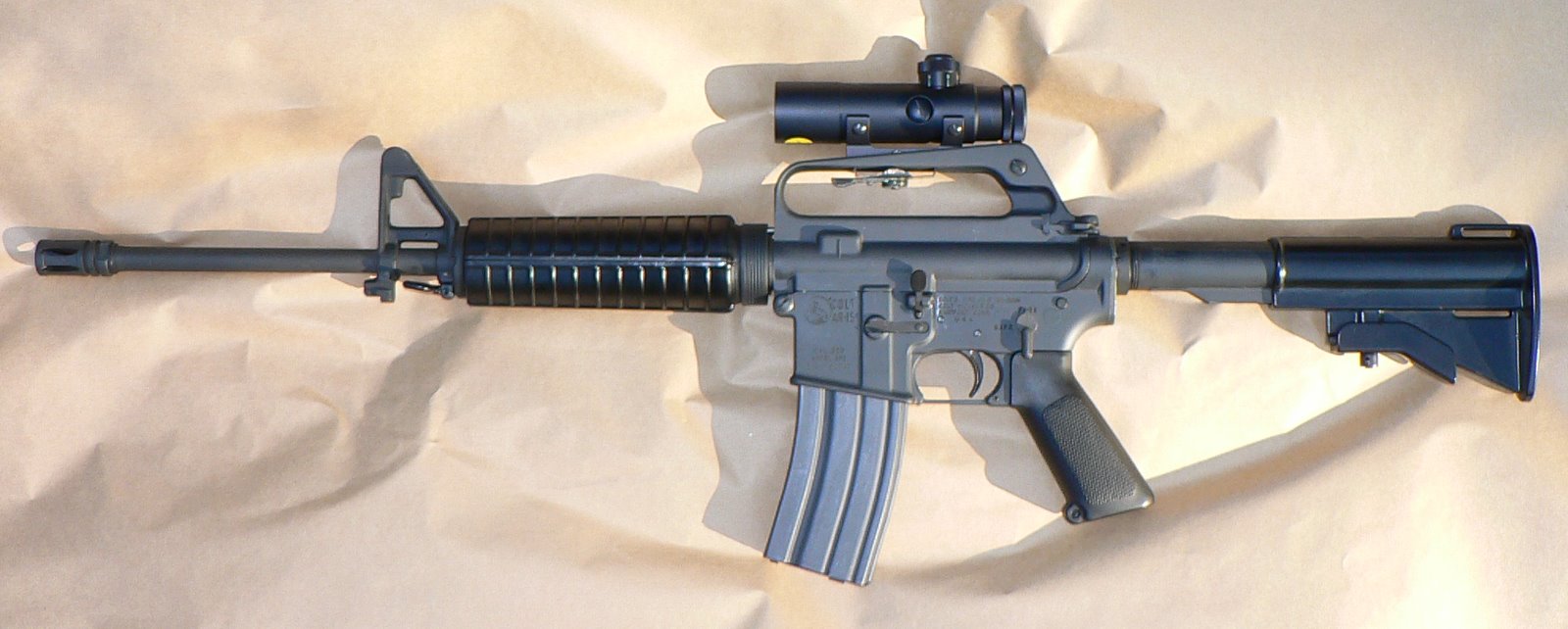
They share a family resemblance and many engineering concepts, but the names describe different historical products, configurations and legal classifications.
| Platform | Typical firing capability | Common configuration | Federal-law significance |
|---|---|---|---|
| Modern civilian AR-15-style rifle | Semiautomatic: one shot for each trigger function | Often a 16-inch-or-longer rifle, but other lawful configurations exist | Not a machinegun merely because it is AR-pattern; exact configuration controls |
| Original ArmaLite / early Colt AR-15 | Select-fire: semiautomatic and automatic | Lightweight 20-inch military rifle | A machinegun under the federal firing-function definition |
| M16 family | Select-fire; automatic or three-round burst depending on variant | Military service rifle, commonly with a 20-inch barrel | Machinegun under federal law |
| M4 / M4A1 family | Select-fire; burst or automatic depending on variant | Military carbine, commonly with a 14.5-inch barrel and collapsible stock | Machinegun under federal law; not the same item as a civilian “M4-style” carbine |
A civilian rifle can resemble an M16 or M4 externally while remaining semiautomatic. Conversely, a firearm's plain appearance does not prevent it from meeting the machinegun definition if its actual operation or regulated components satisfy the statute. Federal classification follows the law and the firearm's objective characteristics—not a marketing label.
The answer depends on which term is being used. In military terminology, an assault rifle is generally a select-fire shoulder rifle firing an intermediate cartridge. The original select-fire ArmaLite AR-15 and military M16 fit that technical concept. A typical modern civilian semiautomatic-only AR-15 does not have select fire.
“Assault weapon” is different. It is a legal or political category whose definition changes from one statute or jurisdiction to another. A state law may classify a semiautomatic firearm according to a named-model list, operating features, dimensions or a combination of characteristics. The term does not have one timeless mechanical meaning.
| Term | What it describes | Why context matters |
|---|---|---|
| AR-15 | A historical name and modern design-family shorthand | The name alone does not establish semiautomatic or automatic fire |
| Assault rifle | A military technical category that includes select-fire capability | A normal semiautomatic civilian AR-15 lacks that select-fire characteristic |
| Assault weapon | A statute-specific legal or policy category | The definition can differ by state, date and law |
| Machinegun | A federal statutory category defined by firing operation and specified parts | It is not determined by color, furniture, caliber or resemblance alone |
No single “AR-15 law” governs every version. Different statutes address machineguns, short-barreled rifles, ordinary firearm transfers and particular semiautomatic configurations.
The NFA regulates machineguns and certain short-barreled firearms, among other categories. The original select-fire AR-15, M16 and M4 fall within the federal machinegun definition because of their automatic firing capability. A semiautomatic AR-pattern firearm can instead become relevant to the NFA because of a short-barreled rifle or another exact configuration—not because “AR-15” appears in its description.
The GCA created the modern federal framework for licensed dealers, prohibited persons and interstate firearm commerce. Title II of the 1968 law also revised the NFA after the Supreme Court's decision in Haynes v. United States. Today both Title 18 and Title 26 matter when discussing machineguns and short-barreled rifles.
The Firearms Owners' Protection Act added 18 U.S.C. § 922(o). Subject to its exceptions, it prohibits transfer or possession of a machinegun. Its grandfather provision protects lawful possession and transfer of machineguns lawfully possessed before May 19, 1986. That is why an NFA repeal by itself would not erase the separate federal barrier to newly manufactured civilian machineguns.
The 1994 federal law restricted newly manufactured firearms and magazines that met its definitions, while exempting qualifying items lawfully possessed before enactment and including other exceptions. Manufacturers continued selling compliant semiautomatic rifles with altered feature combinations. The federal provisions expired on September 13, 2004 under their ten-year sunset clause. State restrictions may still apply, and their definitions are not necessarily the same as the former federal law.
The platform survived its troubled introduction because the underlying architecture solved several practical problems well. Its recoil path is close to the bore line. Aluminum receivers and synthetic furniture reduce weight. The upper and lower receiver arrangement simplifies service and allows manufacturers to offer many barrel lengths, handguards, stocks, optics interfaces and calibers around familiar controls.
For civilian owners, those traits support several legitimate uses: recreational shooting, competition, hunting where the cartridge and local law are appropriate, ranch use, home defense, training and collecting. Parts availability and standardized accessory interfaces helped create a broad manufacturer ecosystem rather than a single-company product line.
The platform also continued to evolve. Fixed carry handles gave way to flat-top optics rails. Polymer and aluminum handguards evolved into free-float systems. Red-dot sights, low-power variable optics, weapon lights and suppressor-compatible muzzle systems became common. The result is better understood as a design family than one frozen rifle model.
To compare operating systems beyond the traditional AR layout, visit Gas Piston, Roller-Delayed & Direct Blowback Explained. To browse receivers and components, see AR-15 Uppers & Lowers.
Modularity is useful, but it is also why configuration questions matter. The same general receiver family can appear as a conventional rifle, a pistol, an NFA short-barreled rifle or a machinegun. Those classifications do not flow from a photograph or nickname alone.
Barrel length alone does not settle the question. Shoulder-fired design, stock or brace configuration, original firearm history, dimensions and current controlling law can all matter.
Adding a vertical foregrip to a pistol can create a different federal classification depending on the firearm's measurements and facts. “It is still a pistol” is not a safe universal assumption.
A suppressor does not convert a semiautomatic AR into a machinegun. It is a separately regulated device and must be matched to the host's caliber, barrel restrictions, muzzle threads and mounting system.
Federal law expressly reaches certain conversion parts and combinations of parts. Cosmetic similarity and mechanical conversion are legally different subjects; never experiment with the latter.
For the classification framework, read SBRs, AR Pistols, AOWs, Vertical Grips and Machinegun Law. For host, thread and muzzle-device planning, use the Suppressor Mounting & Compatibility Guide.
Fairchild Engine Corporation establishes ArmaLite as a small-arms development operation focused on lightweight materials and innovative prototypes.
Eugene Stoner and the ArmaLite team develop the lightweight 7.62 mm AR-10 for military evaluation.
The application that becomes U.S. Patent 2,951,424 documents the expanding-gas bolt and carrier system central to the design lineage.
ArmaLite scales and redesigns the AR-10 concept around the smaller .223 cartridge for new lightweight-rifle requirements.
AR-15 prototypes enter U.S. military testing, demonstrating low weight, controllability and the ammunition-carry advantage of the smaller cartridge.
Colt obtains the AR-10 and AR-15 rights, refines the rifle for production and begins broader international and government marketing.
General Curtis LeMay's interest gives the rifle an influential sponsor inside the U.S. military.
Large government orders formalize the rifle's move from contested prototype to a major U.S. service weapon.
M16 production accelerates while Colt releases the semiautomatic AR-15 Sporter SP1 to commercial buyers.
Combat malfunctions bring public scrutiny to ammunition, maintenance, chrome plating, procurement decisions and field support. Corrective changes feed into the M16A1 era.
A revised service rifle incorporates a heavier barrel profile in key areas, different sights, new furniture, cartridge changes and a three-round-burst mode in common variants.
Federal law generally closes the ordinary civilian market to machineguns not lawfully possessed before the effective date, subject to statutory government and other limited exceptions.
The shorter M4 and later M4A1 extend the operating system into a compact military carbine that becomes visually influential across the civilian market.
Newly manufactured semiautomatic firearms and magazines meeting the law's definitions face federal restrictions, while grandfather and other exceptions preserve a substantial existing market.
The ten-year sunset takes effect. State and local laws remain separate and continue to vary.
Flat-top receivers, free-float rails, new cartridges, modern optics and a growing parts market turn the AR pattern into a broad modular family.
“AR-15” can refer to the original select-fire ArmaLite rifle, Colt's historic commercial line or the wider modern semiautomatic design family. Accurate discussion begins by identifying which one is meant.
ArmaLite developed the AR-15 as a team project in the late 1950s. Eugene Stoner created the AR-10 architecture and central gas-and-bolt concept; L. James Sullivan, Robert Fremont and other ArmaLite personnel helped develop the smaller .223 rifle.
AR means ArmaLite Rifle, reflecting the company that created the model family. It does not stand for assault rifle or automatic rifle.
The design emerged from ArmaLite's AR-10 work during approximately 1956–1958. Prototypes entered U.S. military testing by 1958, and ArmaLite transferred the design rights to Colt in 1959.
Yes, but “designed by Stoner alone” is incomplete. Stoner's AR-10 and patented operating system supplied the foundation. Sullivan, Fremont and the larger ArmaLite engineering team were important to the AR-15's development.
ArmaLite transferred the AR-10 and AR-15 rights to Colt in 1959. Colt then refined, manufactured and marketed the rifle to military, law-enforcement and civilian buyers.
Colt commercially released the semiautomatic AR-15 Sporter SP1 in 1964. Civilian sales therefore began near the start of large-scale M16 military production, not decades later.
No. They share a design lineage, but the M16 is a select-fire military rifle and a federal machinegun. The typical modern civilian AR-15-style rifle is semiautomatic only.
No. The military M4/M4A1 is a select-fire carbine, commonly using a 14.5-inch barrel. A civilian “M4-style” AR may resemble it but normally uses semiautomatic operation and a configuration selected to comply with applicable law.
The original ArmaLite AR-15 and early Colt military versions were select-fire, allowing semiautomatic and automatic operation. Colt's civilian SP1 and the ordinary modern civilian AR-15 are semiautomatic-only designs.
Early failures arose from several interacting problems, including rapid fielding, ammunition changes, unchromed chambers vulnerable to corrosion, inadequate cleaning equipment and poor maintenance guidance. Later technical and support changes substantially improved reliability.
No. The law applied defined named models and feature combinations, contained grandfather and other exceptions, and allowed compliant configurations. Its federal provisions expired on September 13, 2004; separate state laws may still restrict AR-style firearms.
No. Automatic firing capability and barrel length are different legal questions. A short shoulder-fired AR configuration may be an SBR, but a short barrel does not by itself create a machinegun.
This article uses manufacturer history, museum collections, a primary patent, government publications, statutes and licensed archival images. Accessed and reviewed August 28, 2026.
Follow the AR-15's history into the modern questions of configuration, suppressors, operating systems and current NFA law.
SBRs, Pistols & AOWs History of Firearm Silencers Suppressor Mounting Guide 2026 NFA Ruling Update Education CenterEducational information only; not legal advice. Firearm classifications and transfer requirements can depend on exact design, dimensions, components, original configuration, manufacture date, state law and controlling court orders. Confirm current requirements before manufacturing, modifying, transferring, transporting or possessing a regulated configuration.
Information