Texas Guns Firearms History
Who Invented the Silencer? The True History From Maxim to Today
Who developed the first firearm silencer, who bought the earliest commercial models, what did they cost, and why did the federal government regulate them? The documented history is more complicated—and more interesting—than the popular version.

The short answer
The earliest known patented firearm sound suppressor was developed by Swiss inventor Jakob Stahel in 1892. Hiram Percy Maxim later designed and marketed the first commercially successful American silencer, filing his patent in 1908 and receiving it in 1909.
No reliable surviving record identifies the first private retail buyer. Early customers included hunters, target shooters, farmers and landowners. Theodore Roosevelt became the best-known early civilian owner, but there is no evidence that he was the first.
Silencers were not federally banned in 1934. Congress placed them under the National Firearms Act, imposing a $200 transfer tax, registration and advance federal approval. Because a Maxim silencer had sold for roughly $5 to $8.50, that tax functioned as an enormous practical barrier.
Silencer or suppressor: which term is correct?
Both terms refer to the same general device. Hiram Percy Maxim marketed his invention as the Maxim Silencer, and federal statutes continue to use the word silencer. The firearms industry often prefers suppressor because the device suppresses part of a gunshot rather than eliminating every sound.
A suppressor reduces muzzle blast by giving hot, high-pressure propellant gas additional room and time to expand and cool before it reaches the atmosphere. It does not eliminate the sound of a firearm's mechanical action. When a bullet travels faster than sound, it also produces a separate ballistic crack that the muzzle device cannot remove.
For historical and legal discussion, “silencer” is entirely correct. For a technical explanation of what the device actually accomplishes, “suppressor” is usually more descriptive.
The inventor before Maxim: Jakob Stahel
Maxim is commonly called the inventor of the firearm silencer, but the surviving patent record points to an earlier inventor.
On December 21, 1892, Swiss inventor Jakob Stahel received a Swiss patent for a device intended to reduce the noise of a firearm used in slaughtering livestock. His corresponding American patent, titled “Device for Lessening the Noise of Firearms,” was granted on March 13, 1894.
Stahel's design used an expansion chamber to moderate the release of propellant gases. Although the patent discussed humane livestock slaughter, it expressly stated that the device could be applied to other firearms. His U.S. Patent No. 516,236 is therefore the strongest documented candidate for the earliest patented firearm suppressor.
Another Swiss inventor, C. A. Aeppli, patented a “bang suppressor” in 1894. These inventions show that the basic concept existed before Maxim. What they did not create was a durable mass-market product supported by advertising, retail distribution and recognizable branding.
Hiram Percy Maxim makes the silencer commercially successful
Hiram Percy Maxim was born in 1869 and trained as a mechanical engineer. He was the son of Sir Hiram Stevens Maxim, the inventor associated with the Maxim machine gun. The father and son are frequently confused, but the successful commercial firearm silencer was the work of Hiram Percy Maxim.
Later histories place his earliest silencer experiments at approximately 1902. The secure documentary dates are June 26, 1908, when he filed his American patent application, and March 30, 1909, when the patent was granted. He founded the Maxim Silent Firearms Company to manufacture and market the product.

Maxim's U.S. Patent No. 916,885, titled “Silent Firearm,” described successive chambers with curved surfaces or vanes. These surfaces caused escaping gas to rotate and lose energy before it exited the front of the device. The Model 1909 became the first successful commercial version.
The next model used an eccentric, or off-center, body. This allowed the shooter to use the rifle's original sights without the silencer blocking the sight picture. That seemingly simple change illustrates why Maxim succeeded: he was not merely proving that sound reduction was possible; he was refining the device around the way ordinary shooters actually used a rifle.
Who first bought silencers?
The name of the first retail purchaser is not known. No authenticated sales receipt, customer ledger or surviving company record has been found that conclusively identifies one person as the first buyer. Histories that confidently award that title to a famous individual are going beyond the evidence.
Surviving advertisements and company literature do reveal the intended market. Early silencers were promoted to:
- Hunters who wanted to avoid disturbing game or neighboring property
- Target shooters and recreational marksmen
- Farmers controlling pests around livestock and buildings
- Landowners and estate owners who wanted less disruptive shooting
- Military and National Guard organizations exploring specialized uses
Silencers could be purchased from hardware stores and sporting-goods retailers or ordered directly through the mail. Company orders were shipped through the U.S. Post Office in cardboard tubes. Before 1934, there was no federal NFA registration or transfer-approval process.

Theodore Roosevelt: famous user, not proven first buyer
Theodore Roosevelt is probably the best-known early civilian user. At Sagamore Hill, Roosevelt owned and used a Winchester Model 1894 fitted with a Maxim silencer. Family accounts associate it with controlling varmints without creating excessive disturbance around the estate.
Roosevelt's ownership matters because it demonstrates how respectable and ordinary the product's original public image was. The silencer was being used by a former president, hunter and conservationist for practical noise reduction—not portrayed solely as a clandestine weapon.
That makes Roosevelt an important early adopter, but the surviving evidence does not establish that he placed the first commercial order.
Were early silencers expensive?
Early Maxim silencers were not throwaway accessories, but neither were they restricted to governments or wealthy collectors.
The Model 1909 reportedly retailed for approximately $5 with the appropriate coupling or barrel sleeve. In the Model 1910 era, a rimfire version was approximately $5, a centerfire version approximately $7, and a government-pattern version approximately $8.50. Surviving catalog material is preserved by the Cody Firearms Museum's digital collection.
| Early product | Historical price | Approximate 2026 purchasing power | What the comparison tells us |
|---|---|---|---|
| Rimfire Maxim silencer | $5 | About $176 | A meaningful but attainable shooting accessory. |
| Centerfire Maxim silencer | $7 | About $246 | More expensive, but still a commercial sporting product. |
| Government-pattern model | $8.50 | About $299 | Comparable in broad purchasing power to a premium modern accessory. |
| 1934 NFA transfer tax | $200 | About $5,000 | The tax was 40 times the price of a $5 silencer and intentionally prohibitive. |
Long-range inflation comparisons are estimates, not exact measures of wages or household affordability. They are useful here because they show the scale of the 1934 tax compared with the underlying product.
How the silencer changed from sporting accessory to “spy weapon”
Maxim's advertising presented the silencer as considerate shooting equipment. Its selling points included less disturbance, reduced muzzle blast, reduced recoil and more comfortable practice. The device's initial identity was closer to that of a firearm muffler than a cinematic assassin's tool.
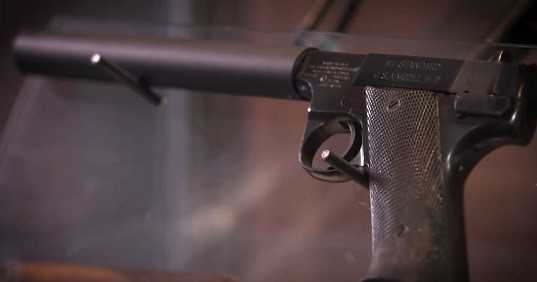
Military use gradually created another image. During World War I, the U.S. military evaluated suppressed rifles and used them in limited specialized roles. During World War II, the British Special Operations Executive employed purpose-built suppressed weapons such as the Welrod, while the American Office of Strategic Services used suppressed High Standard pistols.
The OSS and the White House demonstration
In 1944, OSS director William “Wild Bill” Donovan demonstrated a suppressed pistol at the White House. According to the CIA's historical account, Donovan fired into a sandbag while President Franklin Roosevelt was occupied elsewhere, then revealed what he had done. The episode perfectly captured the suppressor's value for covert operations—and strengthened its association with intelligence services.
Military and intelligence use was real, but it did not erase the device's earlier civilian history. The same basic technology could reduce disturbance on a farm, protect communication during training or support a covert wartime operation. Context—not the tube itself—determined the purpose.
Movies and television later amplified the covert image by depicting a suppressed firearm as nearly silent. That fictional sound effect shaped public understanding far more than the loud mechanical and ballistic reality experienced at a range.
1934: regulated, taxed and registered—not federally banned
Congress enacted the National Firearms Act on June 26, 1934, during intense public concern about organized crime and highly publicized gang violence. The law covered machine guns, short-barreled rifles, short-barreled shotguns and “a muffler or silencer for any firearm.”
The original law imposed a $200 transfer tax and required federal registration and advance approval. Individual transferees supplied identifying information, fingerprints and a photograph. Possession or transfer outside the statutory system became a serious federal crime.
The original text of the 1934 NFA did not declare that no private citizen could possess a silencer. A person who satisfied its requirements could legally acquire one. Nevertheless, the financial burden was devastating to the ordinary market.
A $200 transfer tax was 40 times the retail price of a $5 Maxim silencer. In modern purchasing power, it was roughly equivalent to $5,000. ATF's own history of the NFA explains that the tax was intended to discourage—if not effectively prohibit—transactions in the covered firearms.
Calling the NFA a “ban” communicates its practical market effect, but it is not technically accurate. The better description is a deliberately burdensome tax-and-registration system that pushed silencers out of ordinary retail commerce.
Why did Congress include silencers?
This is one of the areas where folklore has replaced documentation.
The NFA as a whole emerged from the anti-gangster and anti-violent-crime politics of the Prohibition and Depression era. Machine guns and concealable or disguised weapons occupied much of the public and congressional attention. Silencers, however, received surprisingly little focused explanation in the surviving hearings and floor debate.
A popular story says Congress regulated silencers specifically because desperate Americans were poaching wildlife or livestock during the Great Depression. Poaching certainly existed, and a quiet firearm could theoretically assist it. But the primary legislative record does not clearly identify Depression-era poaching as the decisive reason silencers entered the NFA.
The most historically defensible conclusion is that silencers were swept into a broad anti-crime package because lawmakers believed a device that reduced a gunshot could have criminal utility. That conclusion is an inference from the political context and the law's structure—not a thoroughly documented silencer-specific finding by Congress.
From 1968 to the modern suppressor industry
The 1968 Gun Control Act rebuilds the NFA
In Haynes v. United States in 1968, the Supreme Court found that the original possessor-registration arrangement created a Fifth Amendment self-incrimination problem. A person already possessing an illegal, unregistered NFA firearm could effectively be required to report himself.
Congress responded through Title II of the Gun Control Act of 1968. The revised law prevented an already-unregistered NFA firearm from simply being registered by its possessor and restricted the use of application information in prosecutions involving prior or concurrent conduct. The 1968 revisions also established the modern making-tax structure.
Under federal statutory terminology, the silencer itself—not just the firearm to which it may be attached—is classified as a “firearm.”
The 1986 definition expands
The Firearm Owners' Protection Act of 1986 expanded the federal definition to cover a completed silencer, certain combinations of parts and certain parts intended only for assembly or fabrication of a silencer.
The same 1986 law restricted civilian acquisition of newly manufactured machine guns. It did not impose a comparable pre-1986 cutoff on silencers. Newly manufactured silencers continued to enter the NFA transfer system.
Technology and public use evolve
Beginning in the Vietnam era, designers developed suppressors suited to military rifles and automatic fire. Later improvements included stainless steel, titanium and high-temperature alloys; more efficient baffle geometry; quick-detach mounting systems; modular configurations; and designs intended to reduce gas returning through the firearm's action.
By the 1990s and 2000s, suppressors had become familiar equipment for specialized military and law-enforcement units. Civilian interest grew as shooters recognized practical uses that echoed Maxim's original marketing:
- Reducing hazardous impulse noise and muzzle blast
- Improving communication during training and hunting
- Reducing disturbance on rural and private property
- Making recoil and blast less intimidating for new shooters
- Improving control and facilitating faster follow-up shots
A suppressor does not make separate hearing protection unnecessary in every combination. Ammunition, barrel length, action type, environment and the particular suppressor all affect the sound reaching the shooter.
State reform, Rule 41F and electronic Form 4s
State-law reform accelerated during the early twenty-first century. As of August 2026, civilian silencer possession was permitted in 42 states, subject to applicable federal and state requirements. Hunting rules remain a separate state-law question.
ATF Final Rule 41F took effect on July 13, 2016. It required responsible persons associated with trusts and legal entities to submit photographs and fingerprints, while replacing the former chief law-enforcement officer certification with a notification process. ATF relaunched electronic Form 4 filing in December 2021, eventually reducing many transfer-processing times.
The 2025–2026 changes and the current legal landscape
Public Law 119-21, signed on July 4, 2025, made the largest change to federal silencer taxation since 1934. Effective January 1, 2026, the NFA making and transfer tax for silencers, short-barreled rifles, short-barreled shotguns and “any other weapons” was reduced to $0. The law did not similarly zero the tax on machine guns or destructive devices.
ATF initially maintained that the application, background-check, approval and registration provisions remained in force even when the applicable tax was zero. A May 2026 final rule implemented the tax change while retaining the other NFA procedures.
Litigation then produced two important—but different—developments:
- June 18, 2026 — United States v. Comeaux: The Fifth Circuit held that silencers are “arms” for Second Amendment purposes because they make firearms safer and more effective. The court nevertheless affirmed the conviction and applied circuit precedent treating the NFA's shall-issue registration system as presumptively lawful absent abusive fees or delays. Read the opinion.
- August 5, 2026 — Silencer Shop Foundation v. ATF / Jensen: The U.S. District Court for the Northern District of Texas held that the challenged NFA application and registration provisions could not be enforced against untaxed firearms under Congress's taxing power. The permanent injunction benefited the named plaintiffs and the members or customers covered by its terms; it was not a nationwide invalidation of the NFA. Read the opinion and final judgment.
Important current-law distinction
A $0 NFA tax does not automatically mean that every other federal or state requirement disappeared. Likewise, a party-specific injunction does not automatically authorize every dealer or purchaser nationwide to follow the same procedure.
October 11, 2026 update: ATF issued nationwide enforcement guidance on October 9, a later development than the court decisions above. ATF’s October 9, 2026 guidance and FAQ. For the current retail process, see How to Buy a Silencer in Texas.
ATF reported approximately 6.65 million registered silencers in the National Firearms Registration and Transfer Record as of August 4, 2026. That figure counts registered devices, not individual owners. It nevertheless illustrates the scale of the modern suppressor market and the dramatic change from the small mail-order industry Maxim built more than a century earlier.
Firearm silencer history: complete timeline
Frequently asked questions
Who invented the first firearm silencer?
Jakob Stahel holds the earliest known patent identified in this research, beginning with a Swiss patent in 1892. Hiram Percy Maxim developed and sold the first commercially successful American firearm silencer, patented in 1909.
Was Hiram Percy Maxim related to the inventor of the Maxim machine gun?
Yes. Hiram Percy Maxim was the son of Sir Hiram Stevens Maxim, who developed the Maxim machine gun. The son—not the father—created the commercially successful Maxim Silencer.
Who was the first person to buy a Maxim silencer?
No reliable surviving sales record identifies the first retail customer. Theodore Roosevelt was a notable early owner, but the evidence does not establish him as the first buyer.
How much did an early Maxim silencer cost?
Depending on model and caliber, early commercial prices were approximately $5 to $8.50. A $5 purchase in 1910 is roughly comparable to about $176 in 2026 purchasing power.
Did the National Firearms Act ban silencers?
No. The 1934 NFA imposed a $200 transfer tax, registration and federal approval. Legal private ownership remained possible, but the tax was so large relative to the product's price that it effectively destroyed the ordinary retail market.
Were silencers regulated because of Depression-era poaching?
That explanation is widely repeated but is not clearly established by the primary congressional record. The safest conclusion is that silencers were included in a broad anti-crime package, while Congress offered little detailed silencer-specific explanation.
Are silencers actually silent?
No. A suppressor reduces muzzle blast. It does not eliminate action noise, and it cannot remove the ballistic crack created by a supersonic projectile.
Are silencers legal in Texas today?
Texas generally permits lawful civilian silencer possession. For the current purchase and paperwork process, use How to Buy a Silencer in Texas and ATF’s October 9, 2026 guidance and FAQ; the historical requirements discussed above are not a checklist for every present-day transfer.
Primary documents and selected historical sources
- Jakob Stahel, U.S. Patent No. 516,236, “Device for Lessening the Noise of Firearms”
- Hiram Percy Maxim, U.S. Patent No. 916,885, “Silent Firearm”
- Maxim Silencers catalog and price-list materials, Cody Firearms Museum
- History of the Maxim Silencer Company
- National Firearms Act of 1934, 48 Stat. 1236
- ATF: National Firearms Act history
- CIA: OSS suppressor development and Donovan's White House demonstration
- ATF Final Rule 41F
- Public Law 119-21, including the 2026 NFA tax changes
- 2026 final rule implementing the revised NFA tax amounts
- United States v. Comeaux, Fifth Circuit, June 18, 2026
- Silencer Shop Foundation v. ATF, memorandum opinion and order, August 5, 2026
Continue learning with Texas Guns
Explore the Silencer & NFA Resource Center for the complete collection of introductory, historical, safety and legal resources.
Use these resources to move from firearm history to practical ownership, compatibility and current NFA information.
Visit the Education Center Read the Mounting & Compatibility Guide Read the 2026 NFA UpdateEducational notice: This article provides general historical and educational information and is not legal advice. Firearm laws, court orders and agency procedures can change, and a ruling may apply only to particular parties or jurisdictions. Confirm current federal, state and local requirements before manufacturing, possessing or transferring a silencer. Historical prices and present-value comparisons are approximate.
Information