01
Identify the Pistol
Confirm the manufacturer, exact model, generation, optics-ready designation and SKU when available.

Texas Guns Red Dot Reference Center
Match your handgun with the correct red dot, mounting footprint, adapter plate and screws. This guide explains the system so you can identify what fits before you buy or install an optic.
Start With the Basics
A red dot setup is a complete mounting system. The optic’s footprint must match either the slide cut itself or an adapter plate made for that exact pistol.
Confirm the manufacturer, exact model, generation, optics-ready designation and SKU when available.
Determine whether the slide has a direct optic cut, a manufacturer plate system or no factory optic cut.
Confirm the optic’s screw pattern, recoil-lug geometry and overall mounting interface.
Use the correct plate, screw diameter, thread pitch, screw length and manufacturer torque specification.
Optics-ready only means the pistol was designed to accept an optic through a particular cut or plate system. It does not identify the footprint, plate, hardware or optic size required.
Choose the Right Format
Footprint determines mounting compatibility. Size and housing style determine how the optic carries, handles debris and presents the sight picture.
Common on full-size and compact pistols. Usually provides a useful balance of window size, durability and overall weight.
Narrower housing for slimline and micro-compact carry pistols. Confirm slide width as well as mounting footprint.
The emitter is sealed inside the housing, helping keep lint, rain, dirt and debris away from the light path.
A larger viewing window can make the dot easier to track during recoil, but may add width, height and holster considerations.
A slim carry pistol usually benefits from a narrow optic that does not overhang the slide. A duty-size, home-defense or competition pistol may benefit from a larger window or enclosed housing. There is no single best format for every handgun.
Mounting Interfaces
A footprint includes more than the location of two screws. Recoil bosses, indexing surfaces, screw size and optic-body clearance can all affect compatibility.
Standard-width / widely supported
Common examples
Trijicon RMR, RMR HD, SRO and RCR; Holosun 407C, 507C, 508T and 507Comp.
Important distinction
An RMR-footprint optic does not mount directly to every optics-ready pistol. Systems such as GLOCK MOS, Walther PDP and FN MRD normally require the correct pistol-specific plate.
Micro-compact / slimline
Common examples
Holosun 407K, 507K and many current EPS or EPS Carry configurations.
Important distinction
Holosun K is related to the RMSc pattern, but it is not automatically identical. Rear recoil bosses, front-boss height and screw depth can change whether an adapter or modified geometry is required.
Micro-compact / slimline
Common examples
Shield RMSc and various micro optics advertised for RMSc-pattern pistol cuts.
Important distinction
“RMSc compatible” can describe several slightly different implementations. Confirm recoil-lug geometry, screw pitch and screw length for the exact firearm and optic.
Full-size / tall mounting deck
Common examples
Leupold DeltaPoint Pro, EOTECH EFLX and several SIG ROMEO-family applications.
Important distinction
Optics described as using the DPP family of geometry may still differ in screw requirements, recoil bosses or slide-specific fitment. Verify the exact combination.
Enclosed / clamp-style interface
Common examples
Aimpoint ACRO P-2 and C-2.
Important distinction
The ACRO interface is not the same as the Holosun 509T interface or Aimpoint A-CUT. A dedicated ACRO cut or model-specific adapter plate is required.
Model-specific / verify every component
Common examples
Holosun 509T, Trijicon RMRcc, Aimpoint COA/A-CUT, SIG-LOC and platform-specific Holosun SCS optics.
Important distinction
These names identify separate mounting systems. Do not substitute a visually similar optic or plate without manufacturer-confirmed compatibility.
Mounting Method
Both methods can be dependable when the parts are engineered for one another and installed correctly. The correct choice is determined by the firearm and optic—not preference alone.
Avoid combining multiple adapter plates to force an otherwise incompatible setup. Extra interfaces add height and additional hardware that can loosen or shift. Use one manufacturer-approved mounting solution designed for the exact pistol and optic whenever possible.
Quick Reference
Use this table as a starting point—not as final installation approval. Product generations, factory packages and slide revisions can change the required plate and hardware.
| Pistol Family | Factory System | Typical Mounting Path | What to Verify |
|---|---|---|---|
| GLOCK Gen4 / Gen5 Standard MOS | GLOCK MOS plate system | Optic → matching MOS plate → slide | Full-size versus Slimline, included plate, optic footprint and screw length. |
| GLOCK Slimline MOS / MOS-K G43X MOS, G48 MOS and designated variants |
Cut varies by SKU | Direct mount or thin adapter depending on the specific cut and optic | Check the case label. Current MOS-K is designed for K or RMSc footprints; earlier Slimline MOS geometry may differ. |
| GLOCK + Aimpoint COA | Aimpoint A-CUT | Factory direct-mount COA configuration | A-CUT is not GLOCK MOS, ACRO or RMR. Confirm the exact factory package. |
| SIG SAUER P320 | Varies by slide generation and SKU | Direct DPP-family mounting or model-specific plate | ROMEO1 versus ROMEO1PRO/DPP cuts, supplemental RMR holes, M17/M18 configuration and SIG-LOC packages. |
| SIG SAUER P365 Family | Micro-optic cut; configuration varies | Direct micro mounting or model-specific adapter | Exact slide generation, rear-sight arrangement, footprint and screw depth. |
| Smith & Wesson M&P CORE / OR | CORE or current plate system | Optic → correct M&P plate → slide | CORE generation, Metal versus polymer configuration, plate and plate-specific screws. |
| S&W Shield Plus OR / Equalizer | Micro-optic cut | Direct RMSc-family optic or verified adapter | RMSc versus K geometry and the exact screw set. |
| Springfield Hellcat OSP | Micro-optic cut | Direct RMSc-family optic or verified K adapter | Recoil-boss geometry, plate requirement and screw length. |
| Springfield Echelon | VIS modular mounting system | Optic mounted using the specified pin set and hardware | Correct VIS configuration for the exact optic and current Springfield instructions. |
| Walther PDP | PDP plate system | Optic → correct PDP plate → slide | Slide cut version, plate program eligibility, optic footprint and hardware. |
| CZ Optics-Ready Models P-10 OR, Shadow 2 OR and others |
CZ model-specific plate system | Optic → matching CZ plate → slide | Pistol model, footprint and whether the rear sight is on the slide or plate. |
| FN MRD Models 509 MRD/Tactical and related variants |
FN MRD plate and insert system | Optic → correct plate/inserts → slide | Required plate, insert, screw set and optic-body clearance. |
| HK Optics-Ready Models VP9 OR and designated variants |
HK plate system | Optic → matching HK plate → slide | Exact OR SKU, plate number and optic footprint. |
| Canik Optics-Ready Models | Varies by model and size | Direct micro mounting or included/optional plate system | TP9, METE, Rival and subcompact systems are not all identical. Verify the model and included plates. |
| Beretta, Taurus and Ruger OR Models | Model-specific direct cuts or plate systems | Depends on the exact pistol and factory package | Do not apply one brand-wide rule. Confirm the precise model, SKU, plate and hardware. |
A pistol without a factory optic cut usually requires a properly milled slide, an optic-ready replacement slide or a purpose-built mounting solution. Dovetail-only optic mounts are generally a compromise and should not be treated as equivalent to a properly engineered slide cut.
Popular Model Family
Holosun uses several different mounting systems across its pistol-optic lineup. Similar names do not guarantee the same footprint.
| Holosun Family | Typical Footprint | Size / Style | Fitment Note |
|---|---|---|---|
| 407C / 507C / 508T | RMR | Standard-width open emitter | Direct on an actual RMR cut; uses the correct RMR plate on manufacturer plate systems. |
| 507Comp | RMR | Large-window competition optic | Uses RMR mounting geometry, but the larger housing can affect holster and slide-clearance choices. |
| 407K / 507K | Holosun K | Micro open emitter | Designed for K-footprint cuts. An RMSc-labeled slide is not automatic proof of direct compatibility. |
| EPS / EPS Carry | Often Holosun K | Enclosed emitter | Many current standard models use K geometry and include a conversion plate. Verify the exact EPS model because newer Core or platform variants may use different fitment. |
| EPS Core Variants | Verify Exact Model | Enclosed emitter | Current product variations may be specified for RMSc rather than the K footprint used by other EPS models. Check the full model number. |
| 509T | 509T Proprietary | Enclosed emitter | Requires a 509T interface, dedicated plate or approved adapter. It is not an ACRO-footprint optic. |
| SCS Platform Models | Platform Specific | Low-profile direct mount | The suffix identifies the intended platform. An SCS-MOS, SCS-MP2 and SCS-320 are different mounting configurations. |
| SCS Carry | Holosun K | Micro enclosed emitter | Designed for K-footprint mounting, with adapter use dependent on the pistol’s actual cut. |
The letter often points to a different mounting family. A 507C and 507K do not share the same footprint. Always use the complete model number when selecting an optic or plate.
Beyond the Footprint
Once compatibility is confirmed, select the optic around the pistol’s intended use, slide width, reticle, controls and maintenance needs.
A standard-width optic may physically mount on a compact system yet overhang a narrow slide. Match the optic body to the handgun as well as the footprint.
Open emitters are often lighter and less bulky. Enclosed emitters help protect the light path from lint, rain, dust and debris.
Smaller dots can support a finer aiming reference. Larger dots or circle-dot systems may be easier for some shooters to acquire quickly.
Side- or top-loading batteries can often be changed without removing the optic. Bottom-loading designs may require removal and a zero confirmation.
Optic height, plate thickness and housing shape determine whether factory sights remain visible. “Suppressor height” is not a universal measurement.
Large windows, enclosed housings and forward-projecting optics may require a red-dot-compatible holster or model-specific clearance.
Astigmatism and other vision differences can make a dot appear starred, smeared or irregular. View several reticle sizes and colors in person. A phone camera can also help: if the dot looks round in the photo but distorted to your eye, the optic may not be the cause.
Mount It Correctly
Correct fitment can still fail if the wrong screws, torque or installation procedure are used. The firearm, plate and optic manufacturers’ instructions control.
Remove the magazine, verify the chamber is empty and keep ammunition away from the work area.
Verify the slide cut, plate, optic footprint and all supplied hardware before assembly.
An overlong screw can bottom out, fail to clamp or contact internal slide components. A short screw may not provide adequate thread engagement.
Clean mating surfaces and use threadlocker only when the component manufacturer specifies the correct type and procedure.
Hand-start screws, seat the optic or plate evenly and use the manufacturer’s current inch-pound specification.
Confirm normal firearm operation, then live-fire zero the optic at a distance appropriate for the intended use. Recheck mounting hardware as directed.
“Boresighted,” mechanically centered or factory mounted does not mean the optic is precisely zeroed for the individual pistol, ammunition and shooter.
Common Questions
No. The pistol still uses a particular direct cut or plate system. You must match the optic footprint, plate and hardware to the exact firearm.
No. Standard GLOCK MOS is a pistol-side plate system. RMR is an optic footprint. An RMR-footprint optic normally attaches to the appropriate MOS-to-RMR plate unless the slide has a separate direct-mount system designed for that optic.
No. They share related dimensions, but recoil bosses, lug height and screw requirements can differ. Some current pistol cuts accept both; others require an adapter or a specific optic configuration.
No. The 507C uses the larger RMR footprint, while the 507K uses the smaller Holosun K footprint.
No. The COA uses Aimpoint’s A-CUT interface. ACRO optics use the separate ACRO mounting interface.
Not always. Iron-sight visibility depends on the optic deck height, plate thickness, housing design and pistol sights. Some direct-mount systems work with standard-height sights, while other combinations require taller sights.
Only when the manufacturers confirm the screws have the correct diameter, thread pitch, head geometry and length. Screws that appear similar can still be unsafe or ineffective.
No. Every installed optic should be live-fire zeroed and confirmed on the actual pistol with the ammunition intended for use.
Yes. Bring the pistol and exact optic information to Texas Guns. Installation is complimentary when the optic and required plate are purchased from us. Customer-supplied optic installation is available for $10 when the correct components are present.
Quick Reference Downloads
Open or download these reference charts for a faster model-by-model comparison. Always confirm current manufacturer instructions before installation.
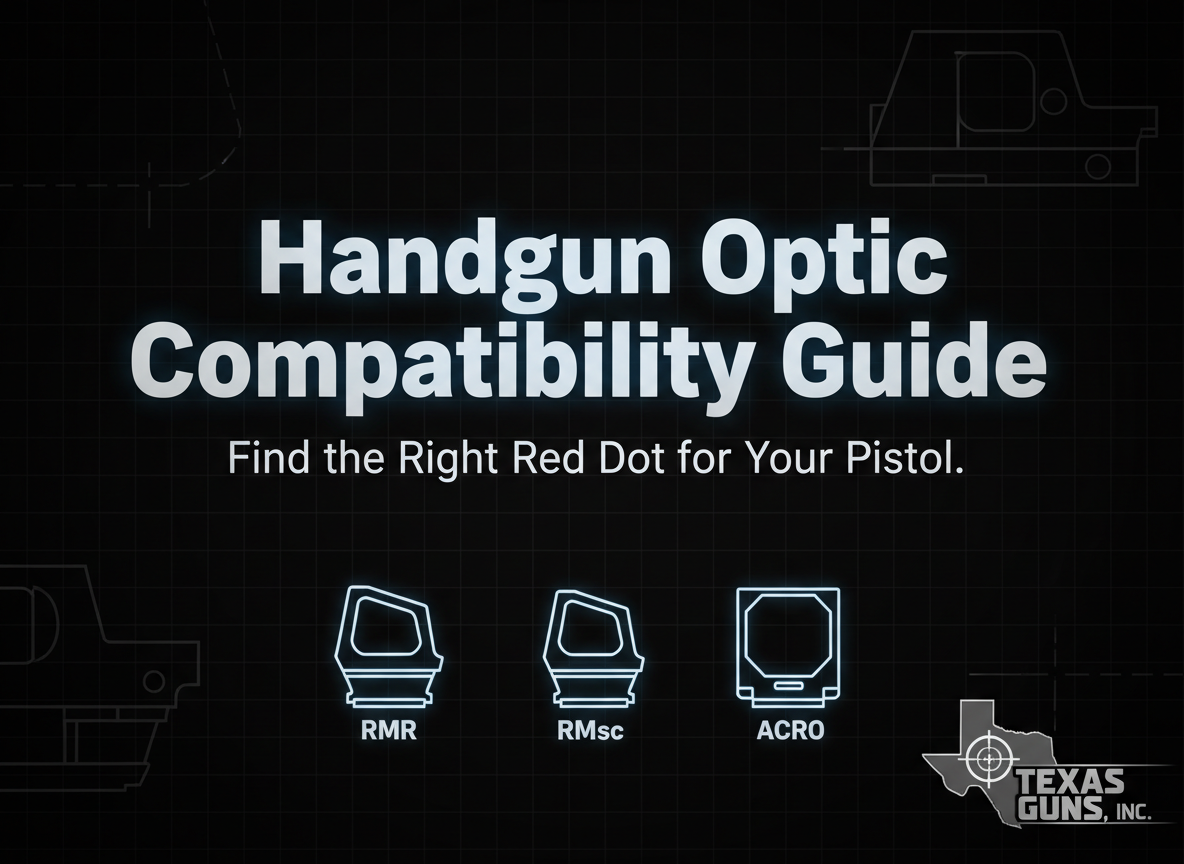
Manufacturer and model reference covering common pistol cuts, direct-fit optics, plate requirements and fitment notes.
Open PDF Guide →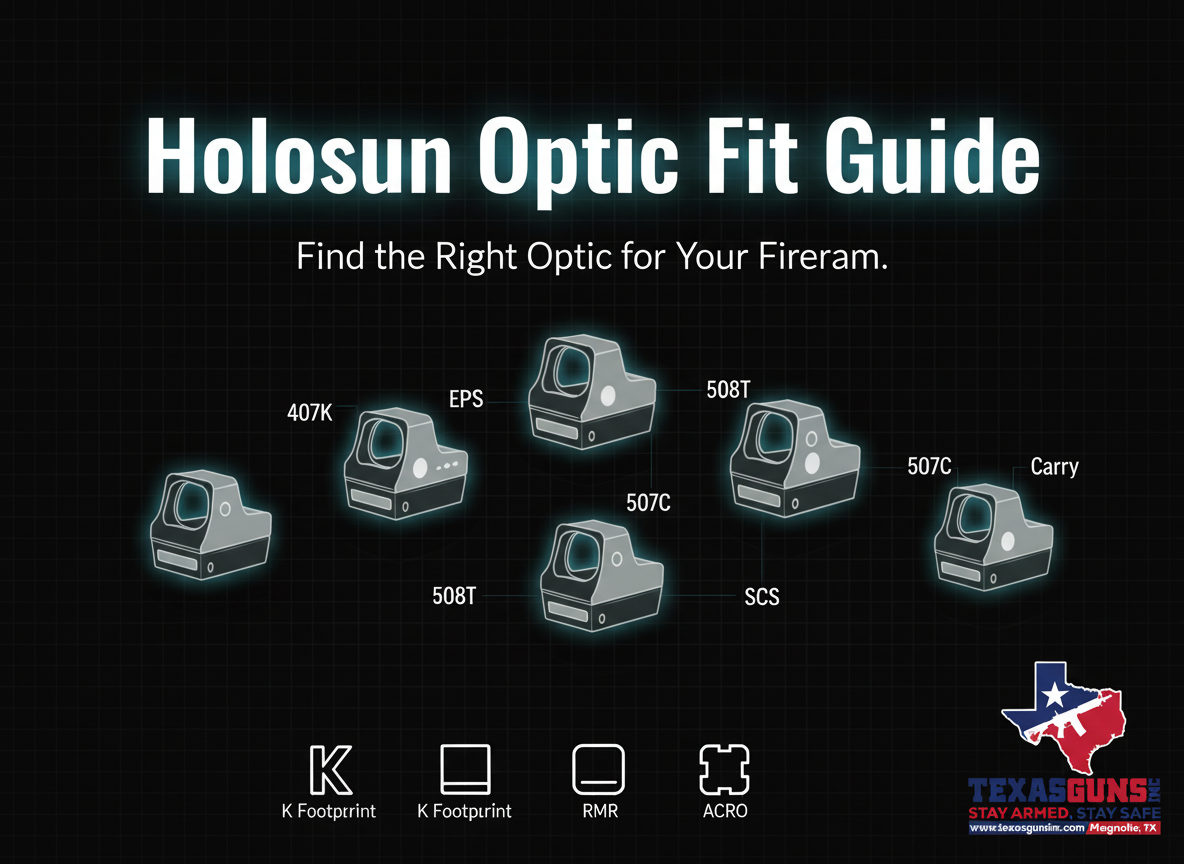
Quick reference for matching popular Holosun handgun optics with compatible footprints, pistol platforms and plates.
Open Holosun Guide →Bring your handgun to Texas Guns. We will identify the slide system, match the optic and plate, verify the hardware and help you avoid buying incompatible parts.
Information