
First Range Day — Done Right
First Time at a Shooting Range? What to Expect and Bring
A practical, no-pressure guide for new shooters who want to arrive prepared, understand the rules and build confidence safely.
The short answer
Your first range visit does not need to be intimidating.
Most public shooting ranges begin with check-in, a waiver and a review of their safety rules. You will need appropriate eye and hearing protection, range-safe clothing and either your own properly cased equipment or a confirmed rental arrangement. Tell the staff that it is your first visit. A good range officer or instructor would rather answer a basic question before shooting begins than correct a preventable mistake afterward.
The most important preparation is not equipment—it is arriving willing to listen, move slowly and follow every range command immediately.
Start here
A beginner's roadmap to the shooting range
This guide is written for adults visiting an indoor or outdoor shooting range for the first time, including new firearm owners in Magnolia, The Woodlands and northwest Houston. Every facility has its own policies, so confirm the details with the range you plan to visit.
Before you go
Make one phone call before packing the range bag
Range policies are not universal. A quick call or website check prevents the most common first-visit surprises.
Confirm hours and access
Ask whether reservations are required, whether walk-ins are accepted and whether the facility has an age requirement or guest policy.
Ask about equipment
Confirm whether rentals, targets, eye protection and hearing protection are available. Rental policies can be different for solo visitors, new shooters and certain firearm types.
Confirm ammunition rules
Some facilities prohibit specific projectiles, steel cases, steel cores, tracers or outside ammunition. Verify the exact caliber marked on the firearm and the ammunition packaging.
Ask how firearms must arrive
Many ranges require firearms to enter unloaded and secured inside a case. Follow applicable law and the facility's instructions. Do not enter with a firearm exposed in your hand or remove a holstered firearm in the lobby.
Review health considerations
Indoor ranges are loud even with protection. Anyone who is pregnant, has a hearing condition or has concerns about lead exposure should consult an appropriate medical professional before participating.
Consider instruction
If you have never safely loaded, unloaded and cleared the firearm, a beginner class or private lesson is the right starting point—not trial and error in a rented lane.
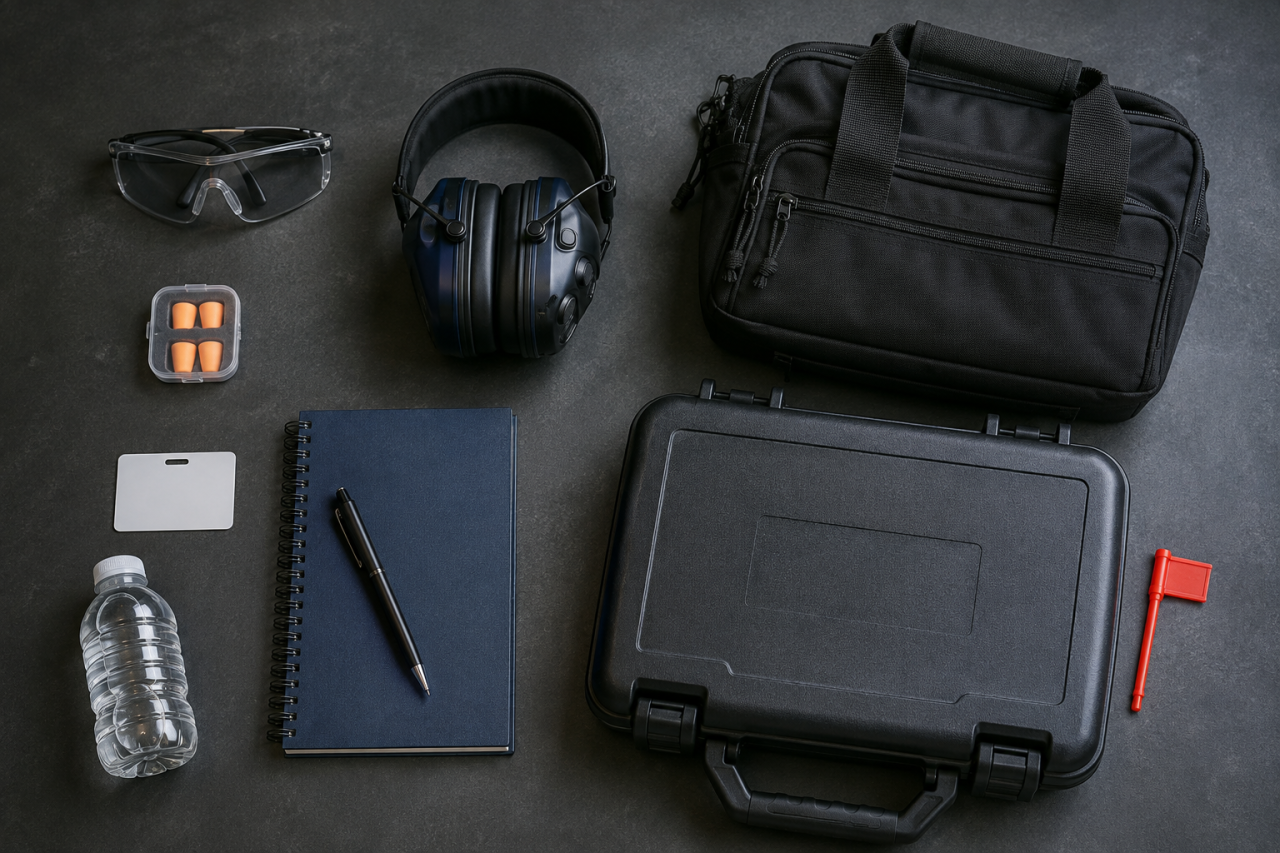
Prepare the equipment before leaving home, but keep the firearm secured until range staff directs you to unpack it.
The range bag
What should you bring to a shooting range?
Bring only equipment you understand and can safely manage. A cluttered bench makes a first visit harder, not easier.
- Government-issued photo identification and any reservation confirmation
- Impact-rated eye protection for the shooter and every observer
- Quality hearing protection; foam plugs under earmuffs are a smart choice indoors
- A properly cased firearm, transported in accordance with law and range policy
- The exact ammunition specified by the firearm manufacturer and allowed by the range
- Compatible magazines if applicable
- Targets if the facility does not provide or sell them
- A small notebook, water and basic cleaning cloth for comfort and notes
Do not rely on appearance when matching ammunition. Read the caliber or gauge marking on the firearm and compare it with the complete designation printed on the factory ammunition box. If anything is unclear, stop and ask a qualified person.
Dress for the environment
What should a beginner wear to an indoor shooting range?
Range clothing is safety equipment. Semi-automatic firearms can eject hot cartridge cases, and an unexpected piece of hot brass inside clothing can cause an involuntary movement.
Closed-toe shoes
Wear stable footwear that protects the feet and supports a balanced stance. Avoid sandals, flip-flops and high heels.
High neckline
Choose a crew-neck or similarly closed shirt. Avoid loose collars or low-cut tops that can collect hot brass.
Comfortable fit
Wear clothing that permits normal movement without loose cords, scarves or accessories around the hands and controls.
Non-negotiable fundamentals
The four primary rules of firearm safety
These rules work together. Following only three out of four is not enough.
Treat every firearm as if it is loaded.
Do not assume. Personally verify the condition while maintaining a safe direction.
Keep the muzzle pointed in a safe direction.
At most ranges, that means downrange toward the designated backstop—never toward another person.
Keep your finger off the trigger until ready to shoot.
Keep the trigger finger straight and visibly indexed along the frame until the sights are on the target and you have decided to fire.
Be sure of the target and what is beyond it.
Fire only at the approved target, in the approved lane and toward the range's designated backstop.
The National Shooting Sports Foundation's safety guidance provides additional explanation of each rule.
Arrival to firing line
What happens when you arrive?
Your exact experience will vary, but a responsible first visit usually follows this general sequence:
-
Check in and identify yourself as a first-time visitor
Present identification, complete the required waiver and say clearly that this is your first range experience.
-
Review the facility's rules
Watch or attend the required safety orientation. Ask questions now; do not pretend to understand an instruction that is unclear.
-
Put on eye and hearing protection
Protection should normally be in place before entering the active range area. Follow posted instructions and staff direction.
-
Enter the assigned lane with equipment secured
Keep the firearm cased until you are at the correct bench and have permission to unpack it. The muzzle must remain oriented downrange.
-
Begin slowly
Start with one firearm, one magazine and a close, clearly visible target. Accuracy and speed are secondary to safe, repeatable handling.
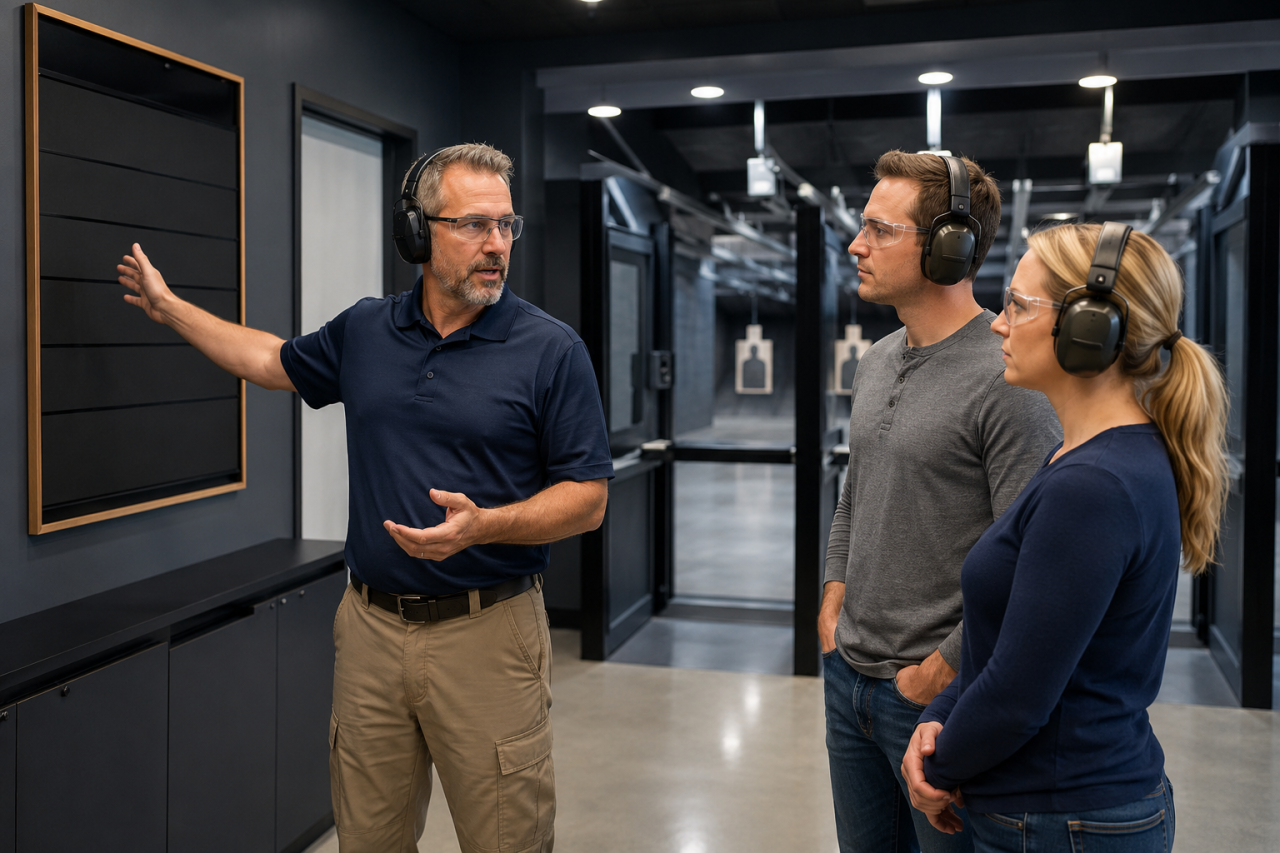
Range officers are there to maintain safety. Listen immediately and ask whenever a command or procedure is unclear.
Know the language
Common shooting-range commands
Specific wording varies. The range officer's instructions always control, and any person who sees an immediate unsafe condition should call for a cease fire.
Stop firing immediately. Keep the muzzle downrange, remove your finger from the trigger and follow the range officer's directions. Do not resume until expressly authorized.
Remove the ammunition source, open the action and verify the chamber is empty as directed. Do not guess at the clearing procedure for an unfamiliar firearm—ask for help.
Firing has stopped. Do not touch any firearm or equipment on the shooting bench. People may be downrange servicing targets.
The range has been returned to active status. This does not mean you must immediately fire; begin only when authorized and personally ready.
Leave the firearm safely positioned as instructed and move behind the designated line. Do not handle firearms again until authorized.
Set realistic expectations
What do the first few shots feel like?
Even when you are not the person shooting, an indoor range produces sharp noise, pressure and vibration. Knowing that beforehand makes the environment much less startling.
The room will feel loud
Quality hearing protection reduces sound exposure but does not make the range silent. Double hearing protection is especially helpful for a first indoor visit.
Recoil should be manageable
The firearm will move, but proper fit, grip, stance and instruction make recoil easier to control. Do not begin with equipment selected merely because it looks impressive.
Speed is not the objective
Load a small number of rounds, pause between shots and focus on safe handling. A successful first session builds repeatable habits instead of chasing a tight group or rapid fire.
Stop, maintain control, ask
What should a beginner do when something seems wrong?
A click instead of a shot, unusual recoil, a strange sound or a firearm that will not operate normally is a reason to stop—not improvise.
The firearm does not fire
Keep it pointed safely downrange. Remove your finger from the trigger and signal the range officer. Follow the firearm manufacturer's instructions and range procedure for a potential misfire.
Something sounds or feels unusual
Do not fire another round. An abnormal sound, reduced recoil or suspected barrel obstruction requires inspection by a qualified person before shooting continues.
You do not know how to clear it
Do not experiment. Maintain a safe muzzle direction, keep the trigger finger straight and ask the range officer or instructor to take over.
Avoid preventable problems
Seven common first-range mistakes
1. Hiding inexperience
Saying “this is my first time” helps the staff provide the correct orientation and support.
2. Bringing the wrong ammunition
Similar-looking cartridges are not necessarily interchangeable. Verify the complete factory designation.
3. Uncasing in the wrong place
Keep firearms secured until you are at the authorized bench and the muzzle can remain safely downrange.
4. Wearing poor clothing
Open shoes, low necklines and loose accessories create avoidable distractions around hot brass.
5. Rushing to fill magazines
Start with a small number of rounds so each loading, firing and unloading cycle remains deliberate.
6. Turning away with the firearm
Keep the muzzle safely downrange. If you need help, place the firearm down as instructed and signal the range officer.
7. Treating instruction as criticism
Immediate corrections are normal in a safety-sensitive environment. Stop, listen and apply the direction.
Real questions. Straight answers.
First shooting-range visit FAQ
Do I need to own a firearm before visiting a shooting range?
No. Many ranges rent firearms, but inventory, eligibility and solo-rental policies vary. Call first and ask what identification, experience or additional conditions apply. A beginner lesson may include suitable equipment.
Should I take a class before going to the range by myself?
If you cannot independently identify the firearm's controls, verify its condition, load it, unload it and clear common stoppages safely, begin with qualified instruction. A class provides structure that an open lane cannot.
How much ammunition should I bring for a first visit?
For many structured beginner handgun sessions, 50 rounds is enough to learn without creating fatigue or information overload. Your instructor or range may recommend a different quantity based on the class, firearm and goals.
Can I bring a friend who is not shooting?
Possibly. Guest, observer, waiver and eye-and-ear-protection requirements vary by facility. Confirm before arriving. Every person entering the range area must follow the same safety instructions.
Can children visit a shooting range?
Minimum ages and adult-supervision requirements are range-specific. A child should only participate through an age-appropriate, closely supervised program and must be able to understand and consistently follow every safety instruction.
What if I am nervous about the noise or recoil?
Tell the instructor or range officer before shooting. Double hearing protection, a properly fitting firearm, a manageable caliber and one round at a time can make the experience more comfortable. You are never obligated to continue if you feel overwhelmed.
Can I arrive with my concealed handgun loaded?
Follow all applicable laws and the specific range's posted policy. Never remove or handle a holstered firearm in the lobby or on the firing line unless the facility expressly authorizes the procedure. Call ahead if the policy is unclear.
What is the best firearm for a first-time shooter?
There is no single best choice for everyone. Fit, hand strength, control layout, recoil tolerance and intended use all matter. A qualified instructor can help select an appropriate firearm without forcing the beginner to adapt to equipment that does not fit.
Build confidence before speed
Not ready to walk onto a range by yourself? That is exactly what beginner training is for.
Texas Guns, Inc. helps first-time owners and new shooters understand safe handling, range etiquette and handgun fundamentals without ego or pressure. Start with the training option that matches your experience, or contact us and we will help point you in the right direction.
Texas Guns, Inc. — Real Questions. Straight Answers.
Magnolia, Texas | Stay Armed. Stay Safe.
Information